

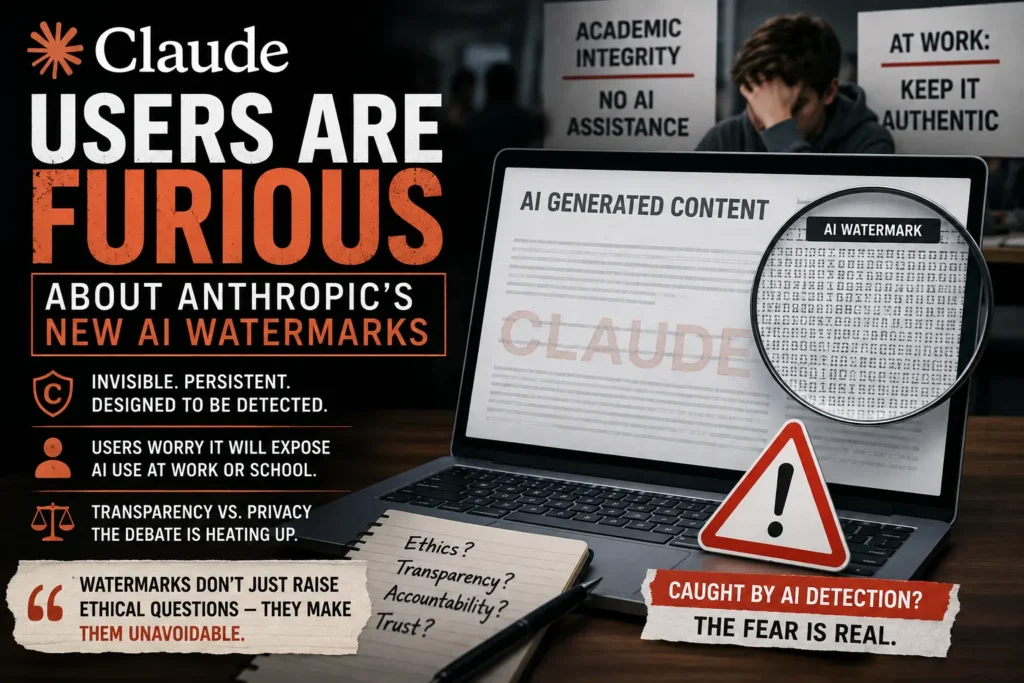
Anthropic’s decision to watermark all text generated by Claude, rolled out to comply with the EU AI Act’s Transparency Code, has triggered a wave of backlash from a vocal subset of users who worry the invisible markers will expose exactly how they’ve been using the chatbot. The debate playing out on Reddit and elsewhere is a useful window into a tension that’s likely to keep resurfacing as AI watermarking becomes standard across the industry.
What the Watermark Actually Does
Anthropic’s system embeds invisible, machine-readable code directly into Claude’s text output, code that persists even when the text is copied and pasted elsewhere, and may survive some editing. The goal is straightforward: let other systems reliably identify content that came from an AI model, satisfying new European transparency regulations that took effect this August.
The Backlash, in Their Own Words
The strongest reactions have come from users who fear the watermark will expose academic or professional dishonesty they were previously able to hide. One Reddit user, whose account was notably only three weeks old, called the system a “draconian conspiracy” designed to “victimize innocent chatbot users worldwide,” arguing that everyday users, not just people trying to pass off AI work as entirely their own, would get caught:
“Who will get caught? You. The student who used Claude to reorganize a paragraph. The journalist who asked the AI to summarize a two-hundred-page transcript. The writer who had creative block and asked for synonyms. Those guys come out of the process with a digital tattoo on their forehead.”
Another critic went further, calling the watermarks “unethical” and “disgusting,” and argued that because they provided the instructions, context, and countless refinements, Claude was merely a “tool” facilitating their labor, not something that should get any kind of implicit credit through a watermark:
“I gave the instructions, context, decisions, and countless refinements, claude was the tool. If Claude starts watermarking the code or anything else it generates, what exactly is it claiming credit for?”
Why the Examples Don’t Hold Up Under Scrutiny
The specific scenarios critics have raised are worth examining directly, because they reveal an important distinction. A journalist who asks Claude to summarize a 200-page transcript isn’t going to be flagged by a watermark, unless they’re copying that AI-generated summary verbatim into a published article without disclosure, which is a real ethical problem independent of any watermark. Similarly, a student who has Claude “reorganize a paragraph” and then pastes that output directly into a submitted essay is engaging in exactly the kind of undisclosed AI use that academic integrity policies already prohibit, watermark or not.
In other words, much of the outrage conflates two different things: the watermark itself, and the pre-existing ethical questions around passing off AI-generated content as fully original human work. The watermark doesn’t create the ethical problem, it just makes it detectable.
Other Users Are Pushing Back Hard
Notably, the backlash hasn’t gone unchallenged. Other Reddit users have been quick to push back on the more dramatic complaints. One simply responded, “Get a load of this guy.” Another told the original poster to take “a deep breath.” A particularly pointed reply to the “unethical and disgusting” critic hit especially hard: “It’s not claiming credit though. It’s about being able to detect AI generated outputs because of the risks AI generated outputs can cause in various situations.” Another commenter noted the irony that the person complaining about Claude had apparently used Claude to help write the complaint itself.
The general sentiment across most threads leans supportive of the watermarking system. As one user put it bluntly: “There is literally no good argument for why this isn’t a good idea. The only reason you wouldn’t want this is to lie to people.”
A More Substantive Criticism Worth Taking Seriously
Not every critique has been dismissible as simple outrage. One more thoughtful complaint raised a genuine point about consistency: Claude and other large language models were trained on enormous amounts of scraped internet content, often without explicit permission from the original creators. Watermarking Claude’s own output, this argument goes, while the underlying model itself was built on unattributed use of other people’s work, does carry a real element of irony worth acknowledging, even if it doesn’t undermine the practical case for watermarking going forward.
What This Debate Actually Reveals
Strip away the more theatrical Reddit posts, and this controversy points to something genuinely important: as watermarking becomes standard across major AI platforms, the line between “using AI as a tool” and “passing off AI work as fully your own” is going to get a lot harder to blur. For years, plausible deniability about AI use has been baked into how people interact with these tools, especially in contexts like schoolwork and professional writing where disclosure isn’t always required or enforced. Watermarking doesn’t change the underlying ethics, but it does remove the ability to quietly avoid those ethical questions altogether.
For continuing coverage of AI industry policy, regulation, and how AI companies are navigating user trust, keep following Tech News Reports for ongoing updates.