

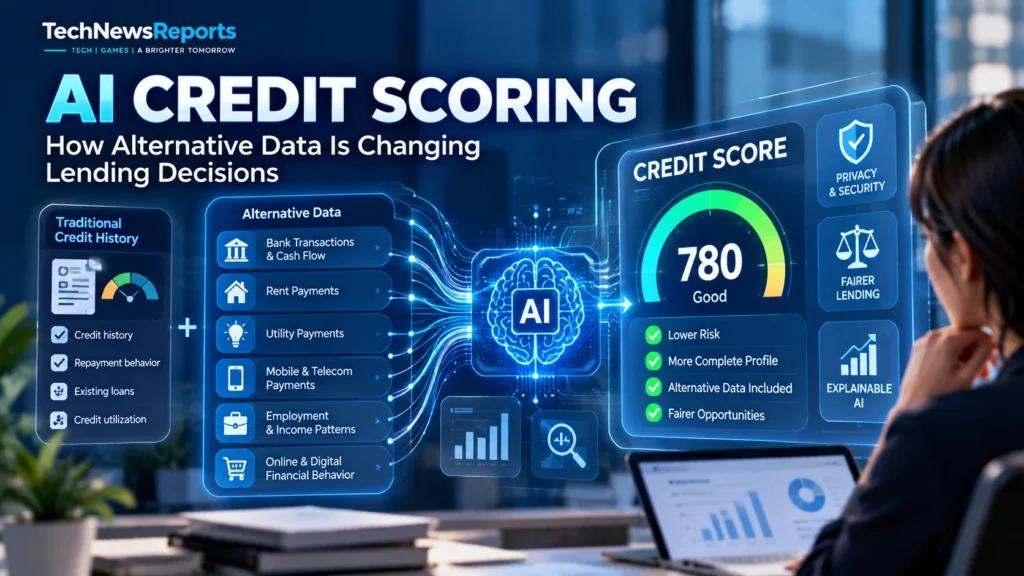
For decades, companies involved in lending activities have been granting or denying credit based on the borrowers’ credit history, repayment behavior, income statement, and existing liabilities. While being fair and relevant, such information does not always show the whole picture, which sometimes can mislead lenders. For instance, customers with little or no borrowing history can have significantly higher risk in terms of default probability compared to those with a good credit history.
This gap is becoming increasingly important as AI in the Fintech Market develops. Artificial intelligence and machine learning can analyze great amounts of structured and unstructured data, contributing to the lenders’ ability to detect financial patterns that traditional scoring models miss. The utilization of alternative data for assessing credit scores is on the rise, especially information on cash flow and other financial behaviors.
Understanding AI credit scoring
What is AI credit scoring? AI credit scoring is the application of artificial intelligence, machine learning, and statistical models to estimate the probability that a borrower will pay back a loan. Conventional credit scoring estimates are based on a predetermined set of features such as past repayment records, current borrowings, credit utilisation, and credit history length.
AI can include far more data. An AI-based technique can incorporate far more data. Rather than using just a fixed set of rules, a machine learning model is trained on historical information and loan performance data to establish how different financial features relate to one another.
That said, credit scores aren’t going away, at least in many credit markets. In many lending scenarios, AI is used in conjunction with existing credit data, not as a substitute. The goal may be to add additional context to a traditional credit score and paint a clearer picture of the borrower.
That’s significant because a more complex model doesn’t necessarily make a better model. Its value depends on the quality of the data that it receives, the structure of the model itself, and how its output is understood.
What is alternative data in lending?
Alternative data refers to data that lies outside of the established credit-reporting model. It can be obtained from a variety of non- and financial sources and can be used to supplement a person’s financial history.
Examples include: cash-flow data. Some of the most important examples of this, where consent is provided, lenders may be able to examine data including: consistent use of income deposits, regular household expenditure, account balances, and how money moves in and out of a bank account.
Additional types of alternative data may be available,e including rental payment history, utility payment history, mobile-phone payment histories, business transaction history,ry and, in some cases, employment or education history. The importance of any particular type of information may differ significantly according to what it is being used for.
According to the Fed, cash-flow data are one of the most promising types of alternative data because, if accessible, it can offer an indication of a borrower’s income and expenses and whether they have the capacity to repay. However, its research also highlights the difficulties around data access, coverage, and quality. (federalreserve.gov)
It also underscores an important point that data availability on its own does not make data applicable for lending decisions. Lenders should also ask whether data is relevant, accurate, legal to consume, and truly related to the kind of credit decision they are attempting to make.
Why traditional credit information does not always tell the full story
Traditional credit histories come in handy when you have a track record of borrowing money and making payments. But not everyone has that kind of history.
An individual with no experience of borrowing through personal loans or credit cards or borrowing from the mainstream financial system will have very little content in their credit file. A thin credit history does not mean the individual has the capacity to repay but rather that there is not enough historical data to make a mainstream assessment.
The Federal Reserve has also referred to the problem of consumers who are considered “credit invisible” and for whom typical scores don’t paint the entire picture of their ability to pay. (federalreserve.gov)
Alternative data may supplement the picture. Regular salary deposits, predictable household payments,s and generally steady account activity can all paint a picture of financial behaviour that wouldn’t be on a traditional credit report.
This same concept can be true of small business. While a small business with less history of borrowing may not have as much of a record to use for comparison, it may have fairly stable expenses and receipt of income from customers. That pattern of receipts and expenses can be another indicator for a lender to look at to determine financial risk.
How artificial intelligence makes sense of alternative data
Capturing more data is just the start; it’s what you do with it that counts.
The standard AI-enabled lending process is data collection first. You gather information from records, bank accounts, credit files, or other sources, subject to circumstances and permissions.
The raw data then has to be processed. The transactions might require categorising, repeated entries deleted, and discrepancies removed. Once the data has been cleaned, the appropriate features can be derived from it.
For example, tens of thousands of individual bank transactions might be employed to generate features on income consistency, expenditure cycles, or cash flow variation, for instance. These features could be included as input features to a statistical or machine learning model.
The model is trained on historical data and known outcomes. When in operation, the model can score new applications and deliver an estimate of risk that is one element of the application decision.
However, the model doesn’t stop there. It is essential to continue monitoring its accuracy because the wider economy, consumers, and quality of data are always evolving. A model that was performing well in certain conditions may not be as effective if conditions change.
Why cash-flow information is attracting attention
One of the most-talked-about use cases for alternative data was cash-flow underwriting because it considers how money actually flows through an account.
Rather than focus mainly on past borrowing, a cash flow assessment can identify trends including stable income, recurrent expenses, levels and/or occurrences of cash shortfalls.
This can in some cases give an even more up-to-date view of somebody’s cash-flow situation. For example, a conventional credit report might reveal that the person has previously handled a loan well, but a table of recent cash-flow data might reveal more up-to-date information.
Cash-flow data have been identified by the Federal Reserve as an area with potential for small-dollar credit underwriting, but also present questions about data availability and quality. (federalreserve.gov)
There are also obvious limitations, of course. Income may be inconsistent, outgoings vary from month to month, transaction categories may sometimes be misleading, and a short-term credit history may not reveal ‘one-off’ expenses or seasonal earnings.
It is for this reason that cash-flow data can be thought of as having only supplementary evidentiary value, rather than being a full account of a prospective borrower’s financial state.
What alternative data could mean for borrowers?
The expanded use of other information may have the following impacts on borrowers, especially those with weak credit history.
A person who is new to mainstream credit products could have more available for a lender to assess. Rather than a thin credit file being the end of the line, a lender could be able to look at other evidence of someone’s financial conduct when the right conditions exist.
Additionally, the time required to make a decision may be adjusted. Technology can analyze vast sums of data significantly faster than a manual review of individual accounts. According to the Federal Reserve, technology and alternative data can enable quicker credit decisions when lending in specific situations. (federalreserve.gov)
But speed doesn’t necessarily mean better. If the information on which the decision is based and the judgment are right, then speed is not only good, it is essential.
Some options for a fuller picture are also available. Conventional credit scores do not offer much detail about a person’s credit history, but additional data can help lenders, and not necessarily in a more useful way, depending on how that data is chosen and used.
The risks that come with using more information
Another benefit of alternative data comes with other formidable challenges.
This is a common problem with data quality. Missing data, wrongly categorised data, or obsolete data can be mistaken for valid signals by an automated model. Being able to interpret data at scale means that a relatively minor flaw in a model can have a high impact.
A further issue is fairness. A variable could seem neutral yet be linked to traits protected by law. The Consumer Financial Protection Bureau has considered the possibility that alternative data could produce a discrimination concern if the seemingly neutral information serves as a proxy for protected traits. (consumerfinance.gov)
Privacy should also be looked at. A consumer might not have any issue with providing information about a specific product but might not be happy for all aspects of their financial behaviour to be assessed as part of their credit application. The simple availability of the information does not make it appropriate to use.
Another concern is overfitting to historical data. Because machine learning algorithms are based on recognizing patterns, any mistakes and long-term trends in the historical data may make their way into the machine learning system itself.
Third, it cannot be assumed that all consumers have similar types of digital financial data. For example, individuals’ digital footprints may be very simple (e.g., straightforward digital banking histories) or complex (e.g., financial arrangements which yield less standardized data). A model that draws heavily on one type of digital information may therefore behave differently for different consumers.
Why explainability matters in automated lending
Perhaps the most common question that is raised around such AI-assisted credit decisions is whether a lender would be able to explain the result to the consumer.
The stakes are high in credit decision-making. There are important reasons why a candidate might want to know the reasons for a rejection and if anything in their application was not right.
In the U.S., the Consumer Financial Protection Bureau has also claimed that even for decisions made by complicated algorithms, creditors are still obligated to use detailed and relevant reasons for unfavorable credit decisions. AI doesn’t eliminate the relevant obligations for credit decisions regarding explanations. (consumerfinance.gov)
This becomes especially true for models that are hard to explain. It’s not enough for an explanation to be technically right if the consumer does not know how to interpret it or spot a mistake.
A study by the UK’s Financial Conduct Authority looked at the impact of different kinds of explanations on consumers’ actions after an AI-informed credit decision. One of its conclusions: The type of explanation can influence whether consumers notice errors in the data or decision process. (fca.org.uk)
It’s therefore not just a technological challenge. It is also a practical element of supporting consumers to be able to understand and challenge decisions if something does not seem right.
Regulation and responsible use
As AI plays a bigger role in lending, a responsible approach to governance grows in importance.
A lender also needs to understand the source of its data, the purpose for which certain data will be applied,d and whether the data is of adequate quality for the decision in question. It needs procedures in place to monitor the model once implemented rather than just assuming the model will never age.
Testing for potentially unfair results is also part of the process. If a model causes differences between groups of consumers that might be considered undesirable, those should be explored rather than assumed to be an inevitable effect of automation.
For third-party providers, this may be another complication. Banks and other lenders can purchase data, analytics,s and automated decision-making from third-party companies. US bank regulators have warned of the need for proper risk management when banks use third-party providers, especially in relation to consumer and compliance risks. (federalreserve.gov)
In the UK, the FCA has explored the quality and completeness of consumer credit data. As there is a need for good credit data for lending decisions, it has highlighted the value of proper data (fca.org.uk).
Collectively, these form a set of factors that illustrate why responsible use is not just about choosing the best algorithm. Data governance, consumer protection, oversight and accountability are also critical elements of the lending process.
What lenders should consider before using alternative data
If lenders are going down the path of alternative data, ta then they should begin with the credit issue before technology.
The first thing that a lender must identify is what they are actually trying to predict. Once the purpose is in mind,ind then it is easier to see if a specific type of information is truly relevant.
Is the Data Reliable? If the data is missing, inconsistent, or hard to validate,idate then it can cause more problems than it solves.
Also critical to look at are the potential adverse consequences of the data. When you’re testing, go beyond overall model accuracy and consider how the model’s decisions will impact various groups when possible.
For model development, also think about explainability. If you cannot give a valid reason for an outcome, consumers and internal reviewers will have a hard time trying to understand what went wrong when an appeal is made.
Conclusion:n Plan for failure. Nothing is perfect. Good monitoring should be designed to catch errors, to review outlier results, and to update models when they change.
This is where AI should be… Being capable of solving issues, but not necessarily a completely objective decision-making engine that replaces human judgement.
How the technology could develop in the coming years
The adoption of alternative data will probably develop hand in hand with open banking, digital financial services and advances in machine learning.
The ability for consumers to share access to their financial data could also help enable this information to be shared more easily with third-party organisations, if the permissioned access is granted. APIs could also enable the information to be used more efficiently, opening up potential for more automated ways of conducting underwriting. The Federal Reserve notes that APIs and permissioned data are potential enabling technologies for automated underwriting and accelerated lending. (federalreserve.gov)
While this debate over “can versus should” approaches will take center stage, the one around information processed by AI in lending will likely be less about the volume of information used and more about whether certain information should be used.
Concern around privacy, fairness, security, explainability, and data quality will still be present even when models evolve.
As a result, it’s possible that in the future there will be a hybrid of traditional credit data and targeted alternative information – or, even less likely, a full replacement of traditional credit data.
A changing approach to assessing credit risk
The use of AI in credit decisioning is altering both the quantity and nature of the data being considered in the application process. Alternative data is especially helpful when traditional credit histories offer only a partial picture of an individual’s financial situation.
Cash-flow data – the opportunity and the challenge. Cash-flow data reveals a lot about potential and the challenge. Data quality, privacy, fairness and explainability will all play a role in ensuring any such data can be used responsibly.
So perhaps the most important development is not the emergence of these more powerful algorithms. Instead, it is the move to broader appraisals of finance, in which the various inputs are judged on their relative importance and accuracy.
For lenders, that means using AI to augment their established decision-making processes rather than replace good governance. For consumers, it means understanding that the credit decision could rely more on financial data that goes beyond a traditional credit report.
As credit assessment becomes more focused on data, knowing how that data is collected, analysed and applied will be vital in order to improve transparency and accountability.