

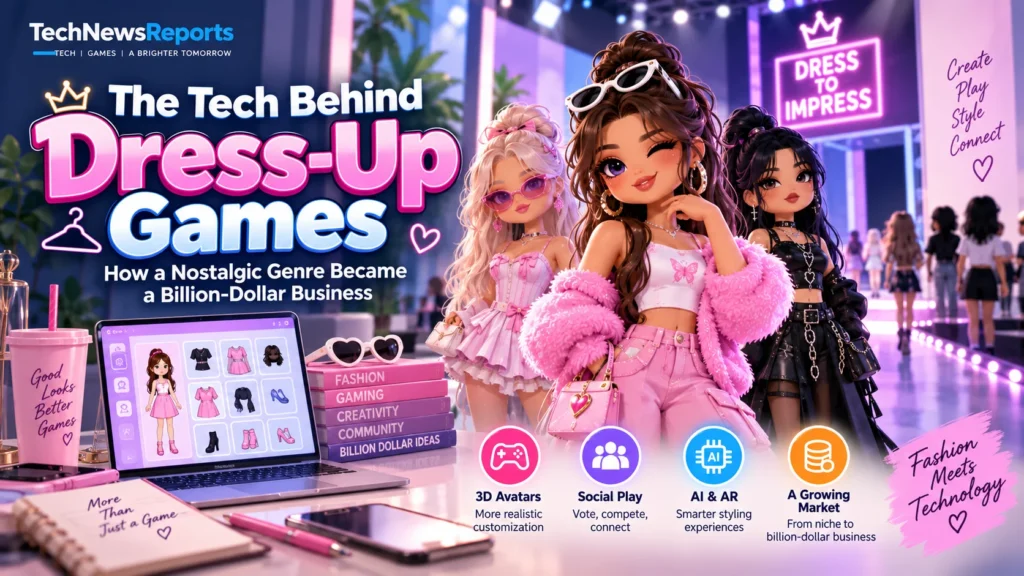
Dress-up games used to mean dragging a paper-doll outfit onto a static cartoon character in a browser window. That genre never went away, it quietly modernized instead, and the clearest proof is a Roblox game built by a single teenage developer that has now been played more than 10.9 billion times. The technology now driving this category, real-time 3D avatars, social multiplayer voting, and increasingly AI and AR features, has turned a genre most of the games industry stopped paying attention to into one of the most-played experiences on the internet’s biggest gaming platform.
The Proof Case: Dress to Impress
No single title makes the case for this genre’s staying power better than Dress to Impress, a Roblox game created by a developer known as Gigi, who reportedly began building it at age 14. Released in November 2023, the game gives players roughly five to six minutes to assemble an outfit around a themed prompt, “Y2K,” “Villain Era,” “Cottagecore,” from a large in-game showroom, then walk a virtual runway to be voted on by other players.
The numbers are hard to overstate. Dress to Impress became one of the fastest experiences in Roblox history to reach one billion visits, hit over 2 billion visits by September 2024, and has since climbed past 10.9 billion lifetime plays, according to Roblox tracking site Rolimons. At its peak, the game drew more than 650,000 concurrent players in a single session, and it has repeatedly ranked among Roblox’s most-played experiences by average concurrent users. Industry revenue trackers estimated the game generating between $2 million and $5 million in a single quarter of 2026 through cosmetic sales and seasonal passes alone, putting it among Roblox’s top ten highest-earning titles.
Part of what fueled that growth was culture, not just gameplay. Streamers including Kai Cenat, Pokimane, and James Charles played the game on livestreams, and a 2024 in-game collaboration tied to Charli XCX’s album “Brat” pushed concurrent players past 600,000 on release day. Dress to Impress went on to win Best New Experience and Best Creative Direction at the 2024 Roblox Innovation Awards.
A Bigger Business Than the Genre’s Reputation Suggests
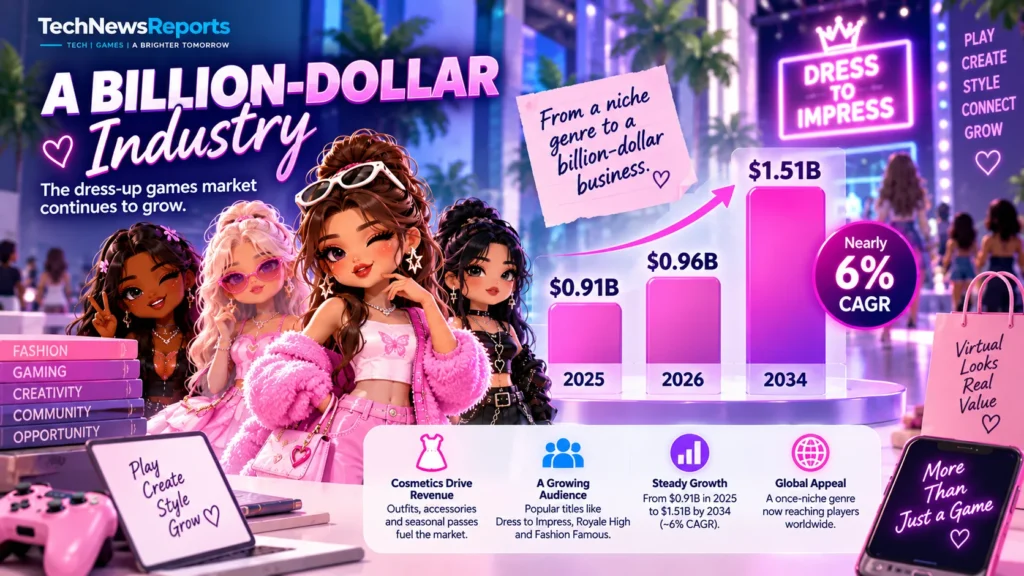
Dress to Impress isn’t an isolated hit. Market research cited by game development firm Cubix puts the broader global dress-up games market at roughly $0.91 billion in 2025, projected to edge up to about $0.96 billion in 2026 and reach $1.51 billion by 2034, according to Business Research Insights, a compound annual growth rate of nearly 6%. A separate, more conservative estimate from Verified Market Research put the category closer to $100 million in 2023 with a comparable growth trajectory through 2031. The gap between the two figures comes down to differing scope and methodology, but both point the same direction: steady, compounding growth in a genre the broader games industry has largely treated as a niche for younger players.
That growth isn’t limited to Dress to Impress. Competing Roblox titles built on the same core loop, including Royale High, known for its expansive wardrobe collection, and Fashion Famous, which runs faster themed rounds, have carved out their own dedicated, cosmetic-spending player bases. Revenue analyses of Roblox’s top-earning experiences in 2026 consistently point to the same pattern across all of them: cosmetics, not gameplay mechanics, drive the majority of revenue in this genre, mirroring how outfit and skin sales already dominate monetization in far larger titles.
From Flash Games to Real-Time Social Avatars
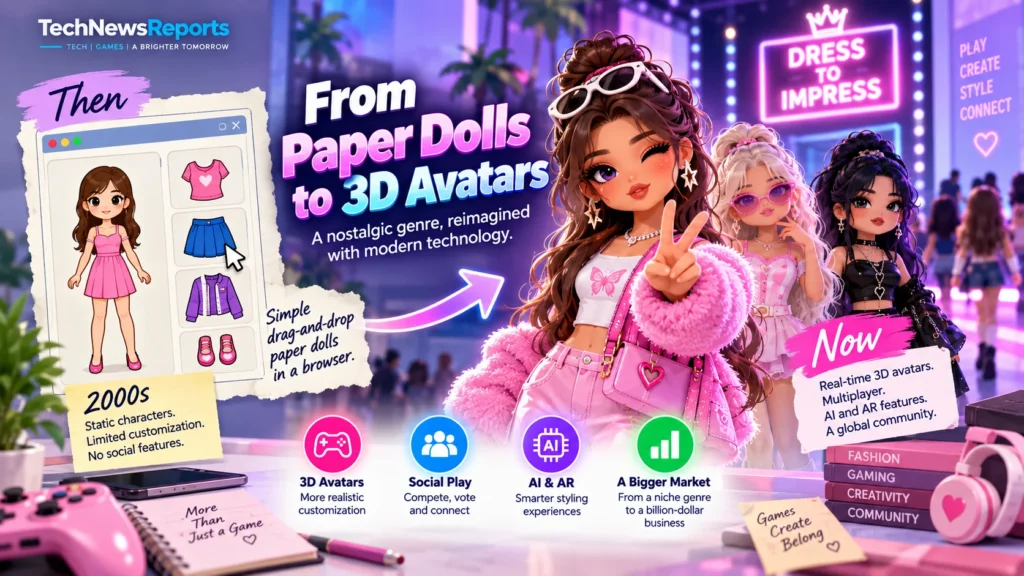
The technical leap behind that growth is significant. Early browser-based dress-up games offered basic drag-and-drop clothing on a static character with no social component at all. Today’s leading titles are built on real-time 3D character engines, in Dress to Impress’s case, Roblox Studio, supporting animated poses, customizable skin tone, makeup, and hair, and critically, live multiplayer interaction: players don’t just dress up alone, they compete, vote, and socialize with other real players in the same session.
That social layer is arguably the single biggest shift separating this generation of dress-up games from their Flash-era predecessors. As one industry analysis of the genre put it, Dress to Impress functions less like a solitary styling app and more like a social virtual try-on experience, one where looks get shared, remixed, and discussed across YouTube, TikTok, and Twitch well outside the game itself. Readers following how real-time engines and social mechanics are reshaping mobile and browser gaming more broadly can find related coverage in our software industry section.
Where AI and AR Fit Into the Genre’s Next Phase
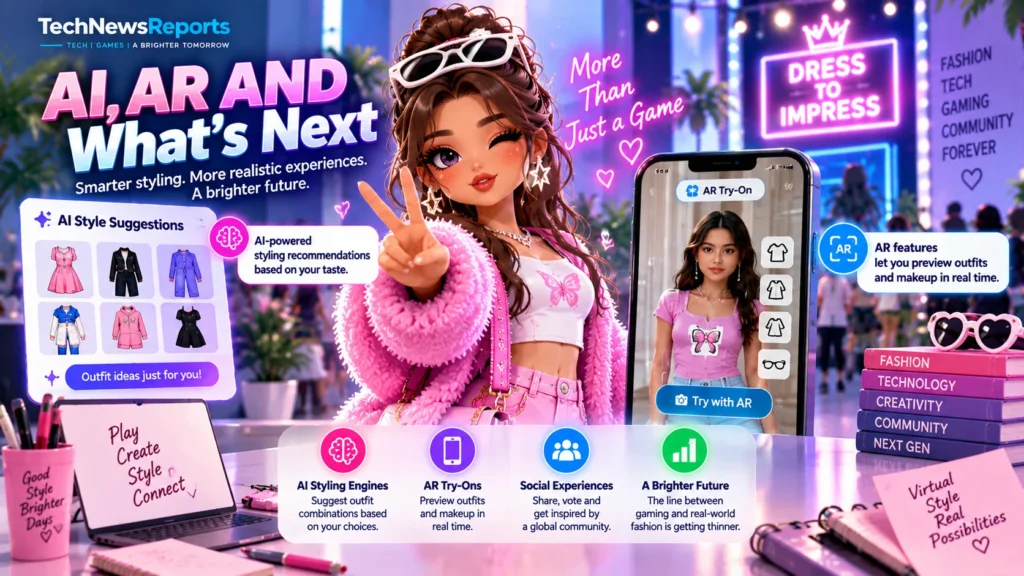
Beyond the current wave of Roblox hits, game studios building standalone fashion apps are increasingly layering in AI and augmented reality. AI-driven styling engines that suggest outfit combinations based on a player’s past choices, essentially a recommendation algorithm borrowed from e-commerce and adapted for a game’s wardrobe system, are becoming more common outside the Roblox ecosystem specifically. Paired with AR features that let a player preview makeup or an outfit through their phone’s camera in real time, the technical line between “playing a dress-up game” and “testing a real product through a retail app” is becoming genuinely thin.
That overlap fits a broader pattern our artificial intelligence coverage has tracked across retail, entertainment, and consumer apps more generally: recommendation and generative AI systems built for one industry increasingly get repurposed, with minimal modification, for adjacent ones.
Why the Genre Has Proven More Durable Than Expected
A few structural factors explain why dress-up games have outperformed their reputation as a niche, younger-skewing genre:
- Low production cost, high replay value. Wardrobe and cosmetic content is comparatively cheap to keep producing on a seasonal or thematic schedule, giving developers a low-cost way to keep players returning without building entirely new game mechanics each update.
- A monetization model built into the genre itself. In-app and in-experience purchases for outfits, accessories, and cosmetic items map naturally onto a genre already organized around collecting and combining virtual items, exactly the “cosmetics are king” pattern revenue analysts point to across Roblox’s top earners.
- A social, spectator-friendly format. Themed rounds and public voting turn every session into shareable content, fueling the same streamer and short-form video ecosystem that helped propel Dress to Impress to viral status well beyond Roblox’s own player base.
- Crossover appeal beyond the traditional audience. Real-world brand collaborations and celebrity-driven attention have pulled in older teen and young adult players alongside the genre’s traditional younger audience, widening the addressable market considerably.
What This Signals for Gaming More Broadly
The dress-up genre’s resurgence, headlined by a game a teenager built on Roblox Studio, is a useful case study in how the games industry keeps finding real, measurable growth in unglamorous corners rather than only in headline-grabbing AAA releases. As real-time engines, social mechanics, and AI-driven personalization tools become cheaper and more accessible to small, even solo, developers, expect more traditionally “casual” genres, dress-up, cooking, decorating, and life-simulation games among them, to keep following the same technical and monetization playbook currently powering fashion gaming’s unlikely rise.
For continuing coverage of mobile and social gaming trends, AI and AR in consumer apps, and the technology reshaping casual gaming, visit Tech News Reports.

