
Every time you stream a show, tap a card to pay, post on social media, or let a fitness tracker log your steps, you’re generating data. Multiply that by billions of people and devices doing the same thing, every second, and you get a scale of information that traditional spreadsheets and databases were never built to handle. That’s the problem big data was created to solve.
This guide breaks down what big data actually means, the framework experts use to define it, how it’s processed, and why it has become one of the most foundational technologies behind modern AI, business analytics, and decision-making.
What Is Big Data?
Big data refers to datasets that are so large, fast-moving, or structurally complex that traditional data-processing tools, such as standard databases or spreadsheets, cannot effectively capture, store, or analyze them.
IBM defines big data as “massive, complex data sets that traditional data management cannot handle,” adding that when properly collected and analyzed, it can help organizations “discover new insights and make better business decisions.” Google describes it similarly, as “an extremely large and diverse collection of structured, unstructured, and semi-structured data that continues to grow exponentially over time.”
In practical terms, big data isn’t defined by one fixed number of gigabytes or terabytes. What counts as “big” today may look ordinary in five years, as storage costs fall and processing power increases. Instead, experts define big data by its underlying characteristics, most commonly described using a framework known as the 5 Vs.
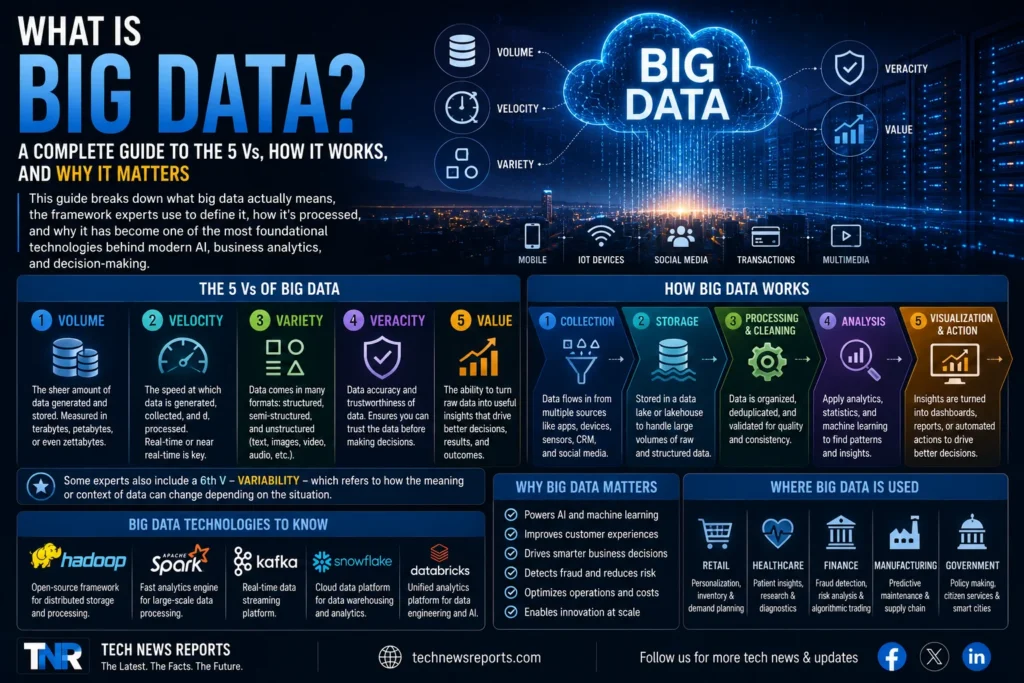
The 5 Vs of Big Data
The 5 Vs framework is the most widely used way to explain what separates big data from ordinary data. The concept originated with the analytics firm META Group (now part of Gartner), which introduced the original three Vs, volume, velocity, and variety, in 2001. Veracity and value were added later as the field matured.
1. Volume
Volume refers to the sheer amount of data being generated and stored. Where organizations once measured data in megabytes or gigabytes, today’s datasets are commonly measured in terabytes, petabytes, or even zettabytes. A single financial services company can process more than 1.5 million transactions an hour, generating over 2.5 petabytes of data, roughly the equivalent of 40 million filing cabinets full of text.
2. Velocity
Velocity describes the speed at which data is generated, collected, and processed. Financial markets, IoT sensors, and online transactions all require data to be analyzed in real time or near real time, not processed in batches days or weeks later. Technologies like Apache Kafka and Spark Streaming were built specifically to handle this kind of fast-moving “data in motion.”
3. Variety
Variety refers to the different formats data can take. Big data isn’t limited to neat rows and columns in a spreadsheet. It includes structured data (like transaction records), semi-structured data (like emails or JSON files), and unstructured data (like videos, images, social media posts, and audio), each requiring different tools and techniques to analyze.
4. Veracity
Veracity concerns the trustworthiness and accuracy of data. With so much information flowing in from so many sources, inconsistencies, duplicates, and errors are inevitable. Veracity is about how much confidence an organization can place in a dataset before using it to make real decisions.
5. Value
Value is arguably the most important V, and the one that ties the other four together. Collecting massive volumes of fast-moving, varied, and trustworthy data means nothing if it doesn’t ultimately generate useful insight. Value refers to an organization’s ability to turn raw data into decisions that improve efficiency, revenue, or outcomes.
Some analysts and organizations now also reference a sixth V, Variability, describing how the meaning or context of data can shift depending on the situation, though the original 5 Vs remain the standard framework most widely taught and referenced.
How Big Data Works
Processing big data generally follows a multi-stage pipeline:
- Collection — Raw data flows in from sources like transactional systems, IoT sensors, social media platforms, customer relationship management (CRM) tools, and connected devices.
- Storage — Because of its volume and variety, big data is often stored in a data lake (which holds raw, unstructured data) or increasingly a lakehouse, a hybrid architecture that combines the flexibility of a data lake with the structure and reliability of a traditional data warehouse.
- Processing and cleaning — Data is organized, deduplicated, and checked for quality issues before analysis, addressing the “veracity” challenge described above.
- Analysis — Analysts and automated systems apply statistical models, machine learning, or business intelligence tools to identify patterns and generate insight.
- Visualization and action — Results are turned into dashboards, reports, or automated triggers that inform real business decisions.
Big Data Technologies to Know
A specific ecosystem of tools has grown up around big data processing, including:
- Hadoop — An open-source framework for distributed storage and processing of large datasets across clusters of computers.
- Apache Spark — A fast, general-purpose processing engine widely used for both batch and real-time data analysis.
- Apache Kafka — A platform for handling high-throughput, real-time data streams.
- MongoDB, Redshift, and BigQuery — Popular database and data warehouse platforms built to store and query large-scale datasets.
- Python, R, Tableau, and Power BI — Common tools used for statistical analysis and turning processed data into visual insights.
Why Big Data Matters
Big data isn’t just an IT concern, it has become a core input for how modern businesses and institutions operate.
It powers artificial intelligence. Modern machine learning and generative AI models require enormous volumes of training data to function. The relationship between big data and AI is symbiotic: better data leads to better-performing AI systems, and AI tools, in turn, are increasingly used to process and extract insight from big data itself. Readers interested in how this connects to modern AI systems can find more detail in our artificial intelligence coverage.
It drives competitive advantage. Retailers like IKEA use big data to forecast demand and streamline supply chains. Streaming platforms like Netflix use it to power recommendation engines. Financial institutions use it to detect fraud in real time. Statista data cited by Coursera found that 62% of employers in North America view AI and big data as core workforce skills through 2030.
It supports better decision-making across industries. In healthcare, big data analysis of lab results and patient records helps improve diagnosis and treatment planning. In education, institutions use it to track outcomes across large student populations. In finance, it underpins fraud detection and risk modeling at a scale no human analyst could manage manually.
For more on how data-driven tools and platforms are reshaping business software, see our broader software industry coverage.
Big Data and Security: A Growing Concern
The same characteristics that make big data valuable, its volume, variety, and the sensitivity of what it often contains, also make it a significant target and responsibility from a security and privacy standpoint. Organizations storing large volumes of customer or transactional data face heightened obligations around data governance, breach prevention, and regulatory compliance. As data breaches involving large-scale datasets have become increasingly common across industries, big data security has become inseparable from big data strategy. For ongoing coverage of data breaches and how organizations are responding, visit our security news section.
What Happens Next for Big Data
A few trends are shaping where big data technology is headed:
- Vector databases and AI integration. As generative AI adoption grows, a new category of database optimized for AI, vector databases, is becoming increasingly important for storing and retrieving the kind of data AI models use to generate relevant, context-aware responses.
- Lakehouse architecture adoption. More organizations are consolidating separate data lakes and data warehouses into unified lakehouse systems, aiming to reduce complexity while preserving both flexibility and structure.
- Stronger data governance requirements. As regulatory scrutiny around data privacy and AI training data increases globally, expect data governance and compliance tooling to become a larger part of how organizations manage big data going forward.
- Continued real-time processing demand. As more industries rely on instant decision-making, from fraud detection to logistics, demand for real-time data streaming infrastructure is expected to keep growing.
Conclusion
Big data describes datasets too large, fast, or complex for traditional tools to handle, defined by the 5 Vs: volume, velocity, variety, veracity, and value. Far from being just a technical buzzword, big data has become foundational infrastructure behind modern AI, business intelligence, fraud detection, healthcare analytics, and more. As data continues to grow in scale and speed, understanding how it’s collected, processed, and secured is becoming essential, not just for data professionals, but for anyone trying to understand how modern technology and business actually work.
For continuing coverage of big data, AI, and the technologies transforming how businesses use information, visit Tech News Reports.