

Artificial intelligence has become one of the most talked-about — and most misunderstood — technologies of the decade. It powers the chatbots people talk to every day, decides what shows up in a social media feed, helps doctors read medical scans, and increasingly writes code, drafts emails, and analyzes financial data on its own. Yet ask ten people to define it, and you’ll likely get ten different answers.
This guide breaks down what artificial intelligence actually is, how it works in plain terms, where it came from, and why it has become one of the defining technologies shaping business, government, and everyday life in 2026.
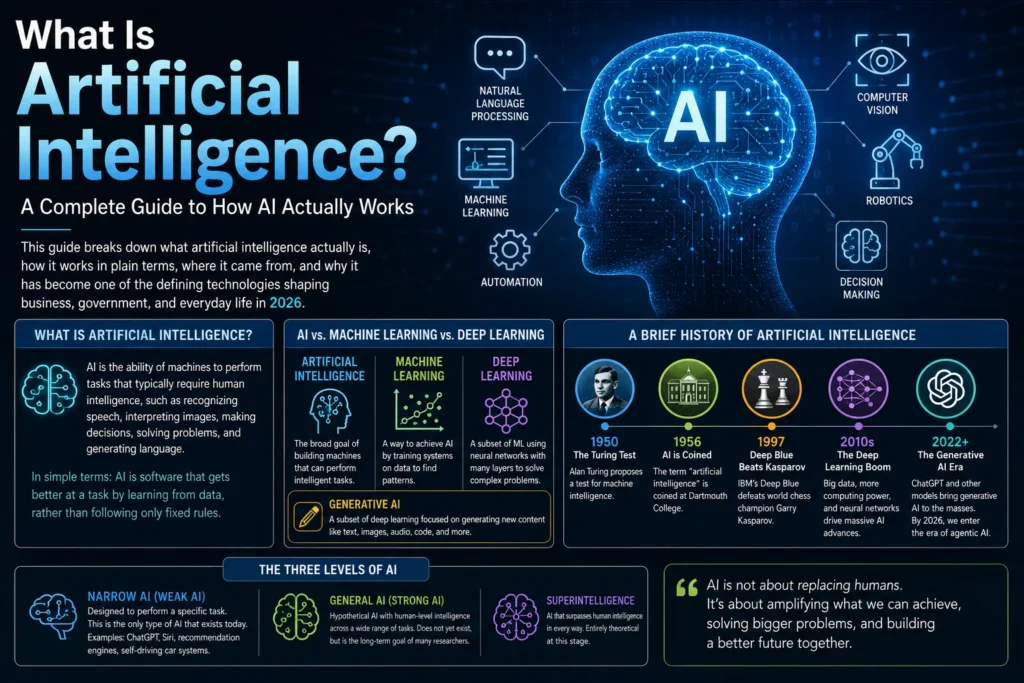
What Is Artificial Intelligence?
Artificial intelligence (AI) is a field of computer science focused on building systems that can perform tasks normally associated with human intelligence — things like recognizing speech, interpreting images, making decisions, solving problems, and generating language.
The Encyclopaedia Britannica defines AI as “the ability of a digital computer or computer-controlled robot to perform tasks commonly associated with intelligent beings,” including the ability to “reason, discover meaning, generalize, or learn from past experience.” IBM describes it more functionally, as technology that enables machines to “simulate human learning, comprehension, problem solving, decision-making, creativity and autonomy.”
NASA, which uses AI in areas ranging from spacecraft navigation to satellite data analysis, notes there is no single, universally agreed-upon definition of AI. Instead, the agency relies on a legal definition from the 2019 National Defense Authorization Act, describing AI systems as those that can perform tasks “under varying and unpredictable circumstances without significant human oversight” or that “learn from experience and improve performance when exposed to data sets.”
Put simply: AI is software that gets better at a task by learning from data, rather than following only a fixed set of instructions a programmer wrote in advance.
AI vs. Machine Learning vs. Deep Learning: What’s the Difference?
These three terms are often used interchangeably, but they aren’t the same thing, and understanding the distinction is key to understanding modern AI.
Artificial intelligence is the broad, umbrella goal — building machines that can perform intelligent tasks.
Machine learning (ML) is one of the main methods used to achieve that goal. Instead of a programmer writing explicit rules for every possible situation, a machine learning system is trained on large amounts of data and learns to recognize patterns on its own. According to Britannica, machine learning is “the method to train a computer to learn from its inputs but without explicit programming for every circumstance.”
Deep learning is a more advanced subset of machine learning that uses layered structures called neural networks, loosely inspired by how neurons connect in the human brain, to process information. Deep learning is the technology behind most of the AI breakthroughs of the past decade, including image recognition, voice assistants, and the large language models behind today’s chatbots.
Generative AI, the term behind most recent AI headlines, refers to a specific application of deep learning: systems trained to generate new content — text, images, audio, video, or code — rather than simply classify or analyze existing data. Tools like ChatGPT, Google’s Gemini, and Anthropic’s Claude are generative AI systems built on a deep learning architecture known as a large language model (LLM).
A Brief History of Artificial Intelligence
AI is not a new idea. The field’s intellectual roots stretch back more than 70 years.
1950 — The Turing Test. British mathematician Alan Turing published “Computing Machinery and Intelligence,” posing the question of whether machines can think and proposing what became known as the Turing Test — a way to judge whether a machine’s responses are indistinguishable from a human’s.
1956 — The term “artificial intelligence” is coined. The field was formally established as an academic discipline at a conference at Dartmouth College, where researchers set out to explore whether machines could be made to simulate human learning and intelligence.
1997 — Deep Blue beats Kasparov. IBM’s Deep Blue defeated world chess champion Garry Kasparov, marking one of the first widely publicized demonstrations of AI outperforming a human expert in a complex strategic task.
2010s — The deep learning boom. Advances in computing power, the availability of massive datasets, and improved neural network techniques led to rapid progress in image recognition, speech recognition, and natural language processing.
2022 onward — The generative AI era. The public release of chatbots like ChatGPT brought generative AI into mainstream use almost overnight, triggering a wave of investment, competition, and adoption across nearly every industry. By 2026, AI has moved well beyond chatbots into what the industry calls “agentic AI” — systems capable of carrying out multi-step tasks, using external tools, and completing workflows with limited human supervision.
The Three Levels of AI
Researchers generally group AI into three broad categories based on capability:
1. Narrow AI (Artificial Narrow Intelligence)
This is the only form of AI that exists today in any proven, widely deployed form. Narrow AI is designed to perform a specific task or a limited set of tasks — recommending a product, detecting fraud, translating language, or generating text. It can be extremely capable within its domain but does not have general reasoning ability outside of it. Every AI system currently in commercial use, from voice assistants to self-driving car software to large language model chatbots, falls into this category.
2. General AI (Artificial General Intelligence, or AGI)
AGI refers to a hypothetical system with the ability to understand, learn, and apply intelligence across virtually any intellectual task a human can perform, not just a narrow set of trained functions. Whether current AI development is genuinely progressing toward AGI, and how close that milestone actually is, remains a subject of active and sometimes heated debate among AI researchers and executives. No credible scientific consensus currently confirms AGI has been achieved.
3. Super AI (Artificial Superintelligence, or ASI)
ASI describes a theoretical future stage in which a machine’s intelligence would surpass human capability across essentially all domains, including creativity, scientific reasoning, and social understanding. This remains entirely speculative and is not something that currently exists.
It’s worth being clear-eyed about this distinction: the AI systems making headlines today, including advanced chatbots and AI coding tools, are narrow AI, not general intelligence, no matter how fluent or capable they may appear in conversation.
How AI Actually Works, in Plain Language
Most modern AI systems, particularly the generative AI tools people interact with daily, follow a similar basic process:
- Training on data. The system is exposed to enormous amounts of information, text, images, code, or other data, depending on its purpose.
- Learning patterns. Using statistical techniques, the system adjusts internal parameters to recognize patterns and relationships in that data, rather than being explicitly programmed with rules for every scenario.
- Generating output. Once trained, the system applies what it learned to new inputs, producing a prediction, classification, or piece of generated content.
- Refinement. Many systems continue to be refined through additional training techniques, human feedback, and testing before and after public release.
Crucially, AI systems don’t “understand” information the way humans do. Large language models, for instance, generate text by predicting the statistically most likely next word or phrase based on patterns learned from their training data, not by reasoning about the world the way a person would. This is why AI systems can produce highly fluent, confident-sounding answers that are sometimes factually incorrect, a phenomenon commonly referred to in the industry as “hallucination.”
Real-World Examples of AI Today
AI is already embedded in far more of daily life than most people realize:
- Virtual assistants and chatbots — Tools like ChatGPT, Google Gemini, and Anthropic’s Claude that can answer questions, draft content, and increasingly perform multi-step tasks on a user’s behalf.
- Recommendation systems — The algorithms behind Netflix, YouTube, Spotify, and e-commerce platforms that predict what content or products a user is likely to want next.
- Fraud detection — Banks and financial institutions use AI to flag unusual transaction patterns in real time.
- Medical diagnostics — AI tools assist radiologists in detecting abnormalities in medical scans and support drug discovery research.
- Autonomous vehicles — Self-driving car systems use AI to interpret sensor data, recognize obstacles, and make driving decisions.
- Voice assistants — Siri, Alexa, and Google Assistant rely on AI for speech recognition and natural language understanding.
- AI coding tools — Products like GitHub Copilot and other AI coding assistants can now generate significant portions of code in professional software development.
- Agentic AI systems — A newer category of AI capable of carrying out multi-step tasks with tools and limited supervision, an area every major AI lab has invested heavily in throughout 2026.
Why AI Matters Now
AI’s rapid adoption is reshaping business, labor markets, and technology investment on a scale few other technologies have matched in such a short period.
Economic impact. Major technology companies have committed hundreds of billions of dollars to AI infrastructure, including data centers and specialized computing hardware, betting that AI will become a foundational layer of the global economy the way electricity or the internet once were.
Workforce transformation. AI is changing how many jobs are performed, particularly in software development, customer service, content creation, and data analysis, generating both productivity gains and genuine concern about job displacement, especially for entry-level roles.
Competitive pressure. Businesses across virtually every sector, from healthcare to finance to retail, are integrating AI tools to remain competitive, whether for customer service automation, fraud detection, or internal productivity.
National strategy. Governments increasingly treat AI capability as a matter of economic competitiveness and national security, leading to growing investment, regulation, and, in some cases, export restrictions on advanced AI models and the hardware used to build them.
Challenges and Concerns
AI’s rapid growth has not come without serious, well-documented concerns that researchers, regulators, and companies are actively working through:
- Bias and fairness. AI systems trained on real-world data can inherit and amplify existing societal biases present in that data.
- Misinformation. Generative AI can be used to create convincing false text, images, audio, or video, raising concerns about fraud, deepfakes, and the erosion of trust in digital content.
- Privacy. AI systems often require large amounts of data, raising questions about how personal information is collected, stored, and used.
- Security. Both the misuse of AI for cyberattacks and vulnerabilities within AI systems themselves have become significant cybersecurity concerns for businesses and governments.
- Job displacement. Automation of tasks previously performed by humans, particularly in entry-level and routine knowledge work, is a genuine and actively studied economic concern.
- Reliability. AI systems can produce confident but incorrect outputs, meaning human oversight remains essential in high-stakes applications like medicine, law, and finance.
What Happens Next
Several trends are likely to define the next phase of AI development:
- Agentic AI expansion. AI systems capable of independently completing multi-step tasks, rather than simply responding to individual prompts, are expected to become increasingly common across business software.
- Regulation. Governments in the U.S., European Union, and elsewhere continue to develop AI-specific regulatory frameworks, balancing innovation against concerns around safety, privacy, and accountability.
- Continued infrastructure investment. Major technology companies are expected to keep investing heavily in the data centers, chips, and energy infrastructure required to train and run increasingly capable AI systems.
- Ongoing debate over AGI. Whether, and when, AI development might approach artificial general intelligence remains one of the most actively debated questions in the field, with no scientific consensus on a timeline.
Conclusion
Artificial intelligence, at its core, is software designed to learn from data and perform tasks that have traditionally required human intelligence. Today’s AI systems, however impressive, remain forms of narrow AI, highly capable within specific domains, but not general, human-like intelligence. Understanding that distinction is essential to making sense of both the genuine value AI already delivers and the very real questions still surrounding its risks, reliability, and future trajectory.