

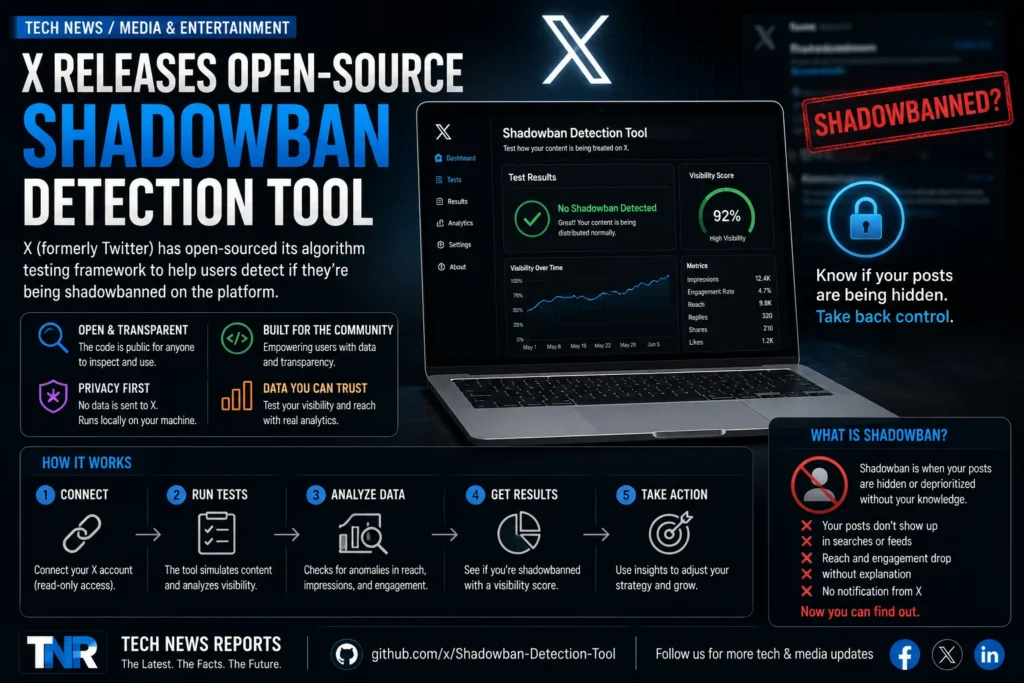
X is dramatically expanding how much of its recommendation system it makes public, releasing the core code behind its “For You” feed on GitHub and, for the first time, giving users a way to check directly whether their own account or posts have been affected by the platform’s ranking systems. It’s the platform’s most significant transparency move since Musk’s original algorithm release back in 2023, and it directly targets one of the longest-running grievances users have had with the platform: the suspicion of being shadowbanned without any way to confirm it.
What’s Actually Being Released
X is publishing the source code for its “For You” timeline, the default feed shown when you open the app, on GitHub under an Apache v2 license. This expands significantly on X’s earlier partial open-source efforts, adding detail that wasn’t previously public, including model configuration, filtering systems, and the core ranking engine itself.
Critically, that means the release includes the actual parameters used to weight different signals, the specific factors that determine which posts get shown to which users and how prominently. According to X’s VP of Product Keith Coleman, the new codebase is roughly 10 to 15 times larger than what the company had previously made public.
“You’ll get the core ranking code that pulls posts and ranks them for any given user and assembles the feed,” Coleman told TechCrunch. “You can see the systems that filter out potentially problematic, rule-violating content… And some of those systems, like the ranker and the score, you can even run yourself outside the company.”
The New “Am I Shadowbanned” Tool
Alongside the code release, X is rolling out a genuinely new feature: a transparency tool inside an “Under the Hood” settings page that lets eligible users download their own aggregate ranking data as a JSON file. Anyone who’s posted 10 or more times in the past month can access this data, which shows whether any labels have been applied to their account or specific posts over the previous calendar month.
For non-technical users, X suggests a fairly modern workaround: drop that JSON file into an AI chatbot of your choice, point it at X’s GitHub repository, and ask the AI to interpret what the data means for your account. It’s a notably practical, if slightly unusual, solution to making raw technical data accessible to ordinary users.
The tool is initially launching to a test group of accounts at least a year old, before X plans a broader rollout.
Why “Shadowbanning” Has Been Such a Persistent Controversy
The term “shadowban” refers to a platform quietly making a user’s posts invisible or undiscoverable to others, without notifying the user their content is being suppressed. It’s been a source of controversy for the platform for years, predating Musk’s ownership entirely. Republican members of Congress previously alleged that pre-Musk Twitter was systematically shadowbanning conservative accounts, allegations the company consistently denied at the time, without ever offering users a concrete way to independently verify those denials.
This new tool is a direct attempt to settle that argument with actual data rather than competing claims. As Coleman put it: “Our dream is that anyone in the public can be able to assess how posts are distributed on the platform, vet that it’s a level playing field, and, if they think it’s not, critique it so we can keep improving it and addressing it.”
What’s Notably Not Included
X was upfront that this release isn’t total transparency. Systems that use Grok, X’s AI model, to predict whether a post might be violating platform rules are specifically excluded from the open-source release. X’s stated reasoning is defensive: publishing those systems could let bad actors reverse-engineer ways to work around content moderation and flood the platform with spam, a legitimate operational security concern that limits how far “full transparency” can realistically go for any platform trying to manage abuse at scale.
An Interesting Contradiction Worth Noting
There’s a genuine tension in X’s broader transparency story that’s worth flagging. While the company is pushing hard on algorithmic transparency here, it’s arguably become less transparent overall in other respects since going private under Musk’s ownership. No longer required to report to the SEC as a public company, X had stopped regularly disclosing user growth metrics, ad revenue figures, and government takedown request data as frequently as it once did. That said, following X’s recent merger with SpaceX, its monthly active user numbers are once again being reported publicly, partially reversing that trend.
Developers Can Now Contribute Directly
Beyond transparency, X is opening the door to genuine community contribution. Developers can submit pull requests, proposed code changes, to the public GitHub repository, which X’s own engineers will review and potentially incorporate into the live algorithm. Coleman expressed genuine enthusiasm about this possibility: “That would be amazing to have people submitting code that improves the algorithm… I mean, how cool would it be for the X algorithm to be not just visible to the public, but also, like, by the public?”
What This Means for Everyday X Users
For the average user, the most immediately useful part of this release is the shadowban-checking tool itself. If you’ve ever suspected your posts weren’t reaching the audience they used to, or wondered whether some account-level restriction was quietly limiting your visibility, this is the first time X has given users a concrete, data-backed way to check, rather than relying on guesswork, screenshots, or anecdotal comparisons with other accounts.
For continuing coverage of social media platform transparency, algorithm changes, and the latest X news, keep following Tech News Reports for ongoing updates.


