
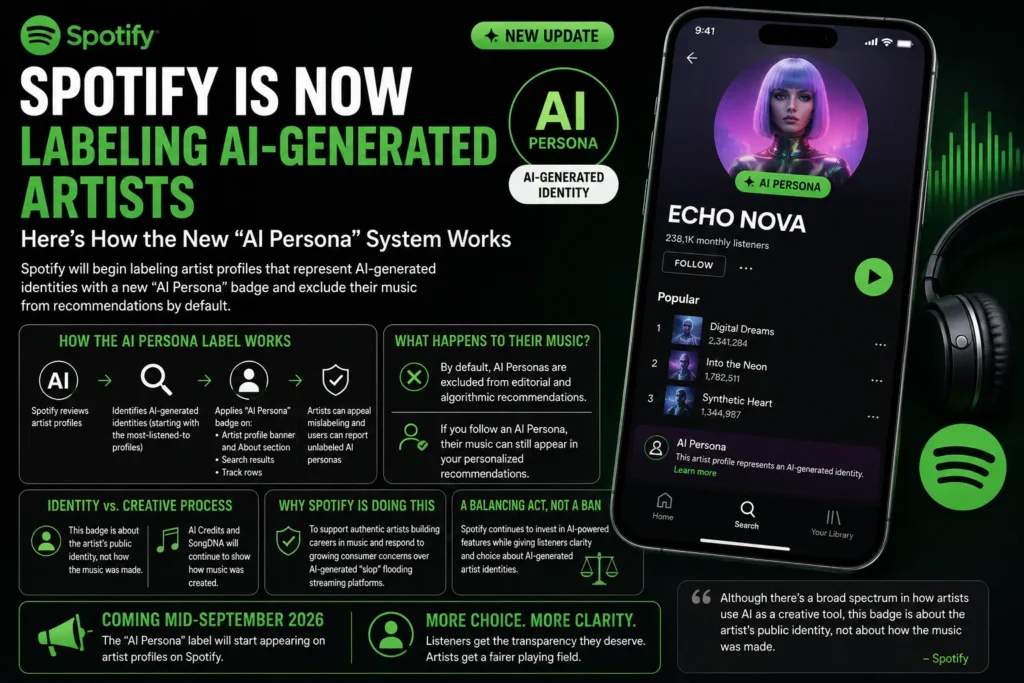
Spotify announced it will begin labeling artist profiles that represent AI-generated identities with a new “AI Persona” badge, and by default, will exclude those artists’ music from its editorial and algorithmic recommendations. It’s Spotify’s most direct move yet to help listeners tell the difference between real musicians and AI-generated acts.
How the AI Persona Label Will Work
Starting in mid-September 2026, Spotify users will begin seeing “AI Persona” badges appear on select artist profiles, marking that the artist’s public identity is AI-generated rather than representing an actual person. Importantly, Spotify says it won’t rely solely on artists voluntarily disclosing this themselves.
The company will also actively review artist profiles and identify cases where an artist’s name and imagery appear to represent a photorealistic AI-generated identity. Spotify said it’s starting this review process with the most-listened-to profiles first, prioritizing artists who’ve already met certain audience thresholds, rather than working through its entire catalog at random.
Once labeled, the badge will show up in several places across the app: the artist’s profile banner and About section, in Search results, and on track rows across playlists, making it visible wherever a listener might encounter that artist’s music.
What Happens to an AI Persona’s Music
This is the part with real teeth. By default, Spotify will exclude AI Personas from editorial and algorithmic recommendations entirely. That means an AI-generated artist won’t get boosted by Spotify’s own curated playlists or personalized recommendation engine, a significant handicap in a streaming ecosystem where discovery is often driven by exactly those two channels.
There’s one exception: if a user explicitly follows an AI Persona artist, that’s treated as a clear signal of interest, and Spotify will include that artist’s music in the user’s personalized recommendations going forward. In other words, listeners can still choose to engage with AI-generated music, but it won’t be pushed on people who haven’t opted in.
Spotify also confirmed artists will be able to appeal their AI Persona label if they believe it was applied incorrectly, and a future tool will let users report artist profiles they suspect are AI Personas that haven’t yet been officially labeled.
Identity vs. Creative Process: An Important Distinction
Spotify was careful to clarify exactly what the AI Persona label does and doesn’t measure. As the company put it: “Although there’s a broad spectrum in how artists use AI as a creative tool, the question of whether a profile represents an actual human is one where Spotify can help make a clear determination. This badge is about the artist’s public identity, not about how the music was made.”
In other words, an artist who is a real, identifiable human but who uses AI tools somewhere in their production process won’t get an AI Persona badge just for that. The label is specifically targeting cases where the artist themselves is a fabricated, non-human identity, not cases where AI was used as a production tool by a real musician.
For listeners curious about how a specific track was actually made, Spotify says that information will continue to be available separately through existing features like AI Credits and SongDNA, tools designed to surface the technical and creative lineage behind a song regardless of whether the artist is human.
Why Spotify Is Doing This Now
Spotify explained its reasoning directly in its announcement: “While we believe all artists have creative choice in determining how they present themselves, Spotify’s programming is focused on elevating music from authentic artists building careers in music.” That’s a clear acknowledgment of a growing consumer backlash against AI-generated content flooding streaming platforms, often described as “AI slop,” low-quality, mass-produced content that AI has made dramatically cheaper and easier to generate at scale.
This move builds on policies Spotify first introduced in September 2025, when it began identifying and labeling AI-generated tracks using industry-standard techniques and banning unauthorized AI voice clones and deepfakes from the platform entirely.
A Balancing Act, Not a Ban
It’s worth noting Spotify isn’t taking an anti-AI stance across the board. The platform continues to invest in its own AI-powered features, including Prompted Playlists, AI DJ, a ChatGPT-like music assistant, and upcoming AI remixes and covers made possible through recent licensing deals with major labels UMG and Merlin. Those remixes will allow fan-made AI covers while still funneling royalty payments back to the original artists.
The AI Persona labeling system exists alongside all of that, and is specifically designed to help listeners distinguish between those licensed, artist-approved AI use cases and profiles built around entirely fabricated artist identities.
What This Means for Listeners and Artists
For everyday Spotify users, the practical impact is straightforward: starting next month, you’ll start seeing clear labels on profiles representing AI-generated artists, and you won’t be algorithmically fed their music unless you specifically choose to follow them. For real musicians, the move is a meaningful, if partial, answer to years of complaints about AI-generated tracks competing for the same playlist slots and royalty pools as human artists, without giving listeners any way to know the difference.
For continuing coverage of AI’s impact on music, streaming, and the broader media industry, keep following Tech News Reports for ongoing updates.