

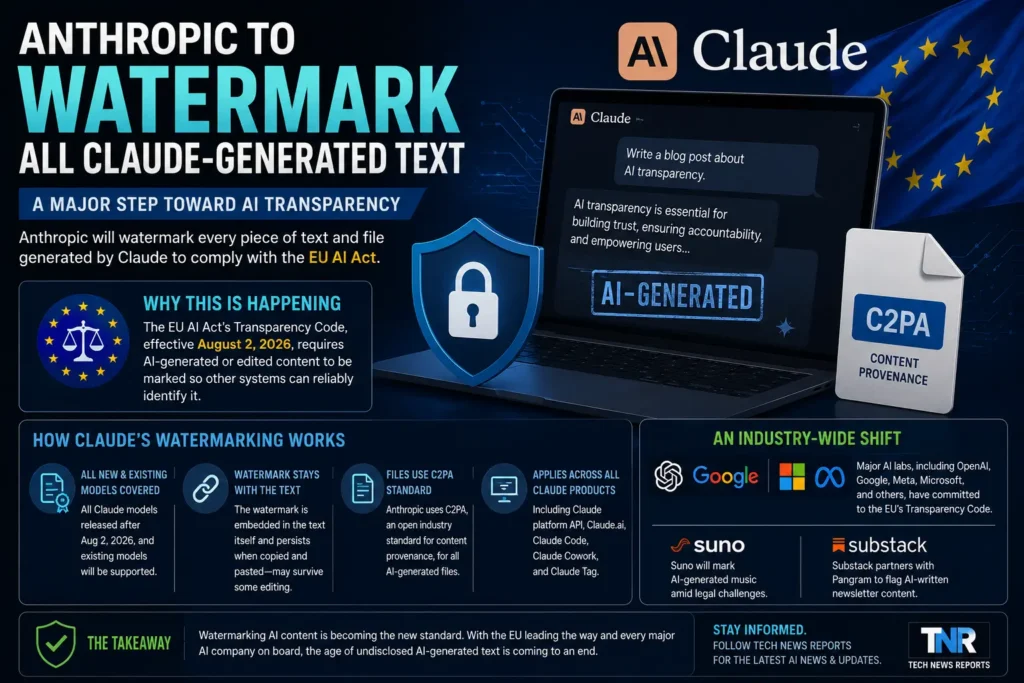
Anthropic has confirmed it will begin watermarking all AI-generated text and files produced by its Claude models, a move driven directly by new European Union regulation rather than a voluntary industry initiative. The change marks one of the most concrete steps yet toward making AI-generated content identifiable at scale.
Why This Is Happening: The EU Is Forcing the Issue
The trigger is the EU AI Act’s Transparency Code, which took effect on August 2, 2026, and requires AI companies to mark AI-generated or AI-edited content in a way that other systems can reliably identify. Anthropic confirmed the change in an updated support page, making clear this is a compliance response rather than a purely voluntary transparency effort.
How Claude’s Watermarking Actually Works
According to Anthropic, all Claude models released after August 2, 2026 will automatically include watermarking technology for both computer-generated text and files. For files specifically, Anthropic is using C2PA, an open industry standard for content provenance that several major tech companies have already adopted for images and video.
A few technical details stand out:
- Older models will get watermarking support too. Anthropic isn’t limiting the rollout to brand-new models only, it’s extending the capability backward to existing Claude versions.
- The watermark travels with copied text. Anthropic says that because the watermark is embedded as part of the text itself, it persists when a user copies and pastes generated content elsewhere, and may survive some amount of editing.
- It’s applied at the model level, not the product level. That means watermarking will be present regardless of which Claude surface generated the text, including the Claude platform API, Claude.ai, Claude Code, Claude Cowork, and Claude Tag.
One open question Anthropic hasn’t yet clarified: exactly how much editing a piece of text needs before the watermark is effectively removed or degraded. That’s a meaningful gap, since it directly affects how reliable the watermark will be in real-world use, where AI-generated drafts are rarely published without at least some human editing.
Not Just Anthropic: An Industry-Wide Shift
Anthropic is far from alone here. Alongside Anthropic, several major tech companies including Black Forest Labs, Google, Meta, Microsoft, OpenAI, and Synthesia have all committed to adhering to the EU’s Transparency Code, meaning watermarking is quickly becoming standard practice across the AI industry rather than a differentiator for any single company.
The trend extends well beyond text generation, too:
- AI music platform Suno recently announced it will begin marking AI-generated tracks, following a string of legal challenges over unauthorized AI-created music.
- Newsletter platform Substack partnered with detection company Pangram to flag AI-generated newsletter content, with Substack’s CEO Chris Best publicly criticizing the practice of using AI to quietly generate content under a human byline, a phenomenon some have taken to calling “Claudefishing.”
Taken together, these moves suggest the AI industry is bracing for a wave of regulatory scrutiny and public backlash over undisclosed AI content, and is choosing to get ahead of it through labeling rather than wait for stricter mandates.
What This Means for Businesses and Content Creators
For anyone using Claude to draft content, whether that’s marketing copy, blog posts, code documentation, or internal reports, this watermarking rollout is worth understanding clearly:
- Watermarking doesn’t mean AI use will be publicly visible by default. It’s an embedded, machine-readable signal designed to let other systems detect AI origin, not necessarily a visible label shown to end readers.
- Heavy editing may reduce watermark reliability, though Anthropic hasn’t specified exactly where that line sits, which is worth watching for anyone whose workflow depends on substantially rewriting AI drafts before publishing.
- This is now a compliance requirement, not an optional feature, at least for any use of Claude touching EU users or markets, which in practice means most global businesses using Claude will be affected regardless of where they’re based.
The Bigger Picture
Watermarking AI-generated content has moved from an academic proposal to enforced regulatory reality in the span of about a year. With the EU’s Transparency Code now in effect and every major AI lab publicly committing to comply, the era of AI-generated text being functionally indistinguishable from human writing, at least from a detection standpoint, is beginning to close. What remains unclear is how effective these watermarks will prove to be against real-world editing, paraphrasing, and adversarial removal attempts, questions the industry will likely spend the next year answering in practice.
For continuing coverage of AI regulation and the latest developments from Anthropic, OpenAI, and the broader AI industry, keep following Tech News Reports for ongoing updates.