
Every business, from a solo freelancer invoicing clients to a multinational corporation closing its books each quarter, needs a reliable way to track money coming in and going out. For decades, that meant ledgers, spreadsheets, and manual reconciliation. Today, most of that work is handled by accounting software, and the category has grown into one of the largest and fastest-moving segments of business technology.
This guide explains what accounting software actually is, the different types available, the features that matter most, and where the category is headed as AI reshapes how businesses manage their finances.
What Is Accounting Software?
Accounting software is a digital tool that helps businesses record, track, and manage financial transactions, automating tasks like invoicing, expense tracking, payroll, tax preparation, and financial reporting that were traditionally done by hand.
According to G2’s software category standards, accounting software is designed to “manage financial transactions, expenses, income, and cash flows within an organization,” automating accounts payable and receivable, journal entries, general ledgers, and financial statements. To qualify as accounting software under G2’s category criteria, a product must maintain a company’s general ledger and chart of accounts, automate accounts receivable and invoicing, automate accounts payable workflows, allow journal entries to adjust transactions, track costs and revenue to determine profitability, and manage cash, bank accounts, and payment methods.
In simpler terms: accounting software replaces manual bookkeeping and spreadsheets with an automated system that keeps a business’s financial records accurate, organized, and up to date in real time.
How Accounting Software Works
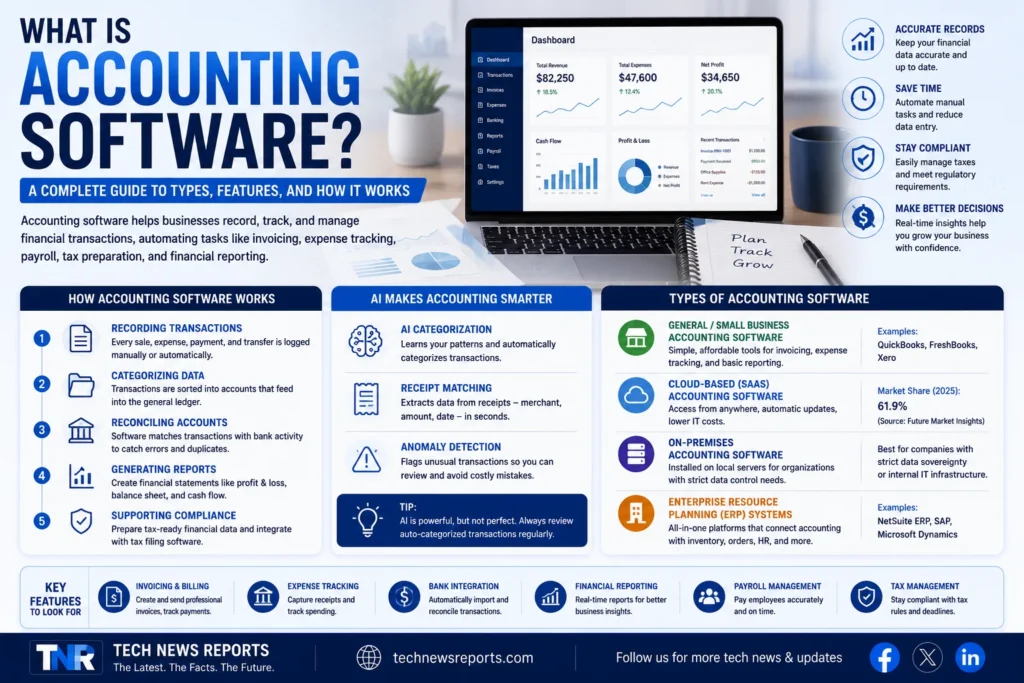
At its core, accounting software connects several financial functions into a single system:
- Recording transactions — Every sale, expense, payment, and transfer is logged, either manually or automatically through bank feed connections.
- Categorizing data — Transactions are sorted into accounts (revenue, expenses, assets, liabilities) that feed into a company’s general ledger.
- Reconciling accounts — The software matches recorded transactions against actual bank and credit card activity to catch errors, duplicates, or unauthorized charges.
- Generating reports — The system produces financial statements such as profit and loss reports, balance sheets, and cash flow statements.
- Supporting compliance — Many platforms prepare tax-ready financial data or integrate directly with tax filing software.
Modern platforms increasingly use AI to strengthen this process. According to a 2026 industry guide on accounting software features, AI-powered transaction categorization can learn a business’s historical spending patterns and automatically tag new transactions, handle receipt matching by extracting merchant, amount, and date data from a photographed receipt, and flag anomalies, such as an unusually large charge from a vendor a business normally spends far less with. The same guide notes that no AI categorization system is currently 100% accurate, and recommends businesses review auto-categorized transactions regularly rather than trusting the output blindly.
Types of Accounting Software
Not all accounting software is built the same way, and the right type depends heavily on a business’s size, industry, and complexity.
General/Small Business Accounting Software
Designed to be simple and affordable, these platforms typically handle invoicing, expense tracking, bank feeds, and basic financial reporting. Popular examples include QuickBooks, FreshBooks, and Xero, and QuickBooks in particular remains one of the most widely used accounting platforms globally, especially among small and mid-sized businesses.
Cloud-Based (SaaS) Accounting Software
Rather than being installed on a single computer, cloud-based accounting software runs on remote servers and is accessed through a web browser or app, offering access from anywhere and reducing the need for in-house IT infrastructure. According to Future Market Insights data cited in industry research, cloud-based accounting software was expected to make up 61.9% of the market in 2025, reflecting a clear shift away from traditional, locally installed systems for most small and mid-sized businesses.
On-Premises Accounting Software
Installed directly on a company’s own servers or computers rather than accessed through the cloud. This approach generally only makes sense for organizations with strict data sovereignty requirements or that already maintain the internal IT infrastructure needed to support it.
Enterprise Resource Planning (ERP) Systems
For larger organizations, accounting functionality is often bundled into a broader ERP platform that also manages inventory, order processing, procurement, and supply chain operations alongside financial management. Platforms like NetSuite ERP combine financial management with advanced analytics and real-time reporting, designed for organizations that need accounting data connected directly to broader operational decision-making.
Industry-Specific Accounting Software
Some accounting software is purpose-built for specific industries with unique financial requirements. Construction companies, for example, commonly use tools like Foundation or Sage 100 Contractor for job costing and project-based billing, features general-purpose accounting software typically doesn’t handle well.
Key Features to Look For
Industry guides published in 2026 consistently point to a core set of features that matter most when evaluating accounting software:
- Automated bank reconciliation — Matching transactions to a company’s books automatically, catching duplicate entries, missing transactions, and unauthorized charges.
- Invoicing with integrated online payment — Allowing businesses to send invoices and collect payment within the same workflow.
- Core financial reporting — Profit and loss statements, balance sheets, and cash flow reports, described by one industry guide as “the three reports every business needs.”
- Tax-ready data and filing integration — Exporting clean, organized financial data directly to a tax preparer or filing platform.
- AI-powered transaction categorization — Automatically sorting expenses based on learned spending patterns, reducing manual data entry.
- Third-party integrations — Connecting with CRM systems, payroll platforms, payment processors, and other business software to eliminate duplicate data entry.
Why Accounting Software Matters
For most growing businesses, spreadsheets eventually stop working. As transaction volume increases, manual processes become slower and more error-prone, and reporting becomes harder to keep accurate and current, exactly the point at which accounting software becomes a practical necessity rather than a convenience.
The efficiency gains are measurable. Research cited by Research.com found that automation delivered through accounting software can save accountants an average of two hours per day that would otherwise go toward manual bookkeeping tasks. Beyond time savings, accounting software reduces the risk of costly human error in financial reporting, supports faster and more informed business decision-making, and makes it significantly easier for businesses to stay compliant with tax obligations and financial reporting requirements.
Accounting software has also become a genuinely large software market in its own right. The global accounting software market was valued at $19.38 billion in 2024 and was projected to reach $31.25 billion by 2030, according to industry market research, growing at an annual rate of roughly 8.4%. Separate longer-term projections from Precedence Research estimate the market could reach $50.79 billion by 2035. That growth reflects a broader shift across the fintech and business software landscape, one our fintech coverage tracks closely, alongside the fintech startups building new tools in this space.
Accounting Software and Fraud Prevention
Because accounting software centralizes sensitive financial data, including bank account details, transaction histories, and payment credentials, it has also become an important line of defense against financial fraud and a target worth securing carefully. Features like automated anomaly detection, which flags unusual transactions that fall outside a business’s normal spending patterns, and audit trails that log every change made to financial records, are increasingly treated as standard requirements rather than premium add-ons. For coverage of how businesses are defending financial systems and data against cyber threats, see our security news section.
What Happens Next
Several trends are shaping where accounting software is headed:
- Deeper AI integration. AI-powered categorization, anomaly detection, and receipt matching are moving from differentiating features to baseline expectations, with platforms like QuickBooks and Xero, which have trained categorization models on millions of small business transactions, holding a meaningful data advantage over newer entrants.
- Continued cloud migration. As cloud-based platforms continue capturing a growing majority of the market, on-premises accounting software is increasingly limited to organizations with specific regulatory or infrastructure requirements.
- Tighter integration with broader business software. Accounting platforms are increasingly expected to connect seamlessly with CRM, payroll, inventory, and ERP systems rather than functioning as standalone tools.
- Growing overlap with fintech. As accounting software increasingly handles payments, lending decisions, and cash flow forecasting directly, the line between traditional accounting software and broader fintech platforms continues to blur.
Conclusion
Accounting software has evolved from a basic digital ledger into a comprehensive financial management system that automates bookkeeping, invoicing, payroll, tax preparation, and reporting for businesses of every size. Choosing the right type, whether that’s simple small-business software, a cloud-based platform, or a full ERP system, depends on a business’s size, industry, and complexity. As AI continues to strengthen automated categorization and fraud detection, and as accounting software increasingly overlaps with broader fintech tools, the category is likely to keep growing as a foundational piece of how businesses manage their finances.
For continuing coverage of accounting software, fintech platforms, and the tools reshaping business finance, visit Tech News Reports.