
The FBI is investigating how a North Korean national was able to secure employment as a remote IT worker at a U.S. federal government agency, according to a senior FBI official speaking at a Washington, D.C. conference. It’s a rare, confirmed case of North Korea’s long-running fraudulent employment scheme successfully breaching a government institution, not just the private companies it’s more typically known for targeting.
What We Know So Far
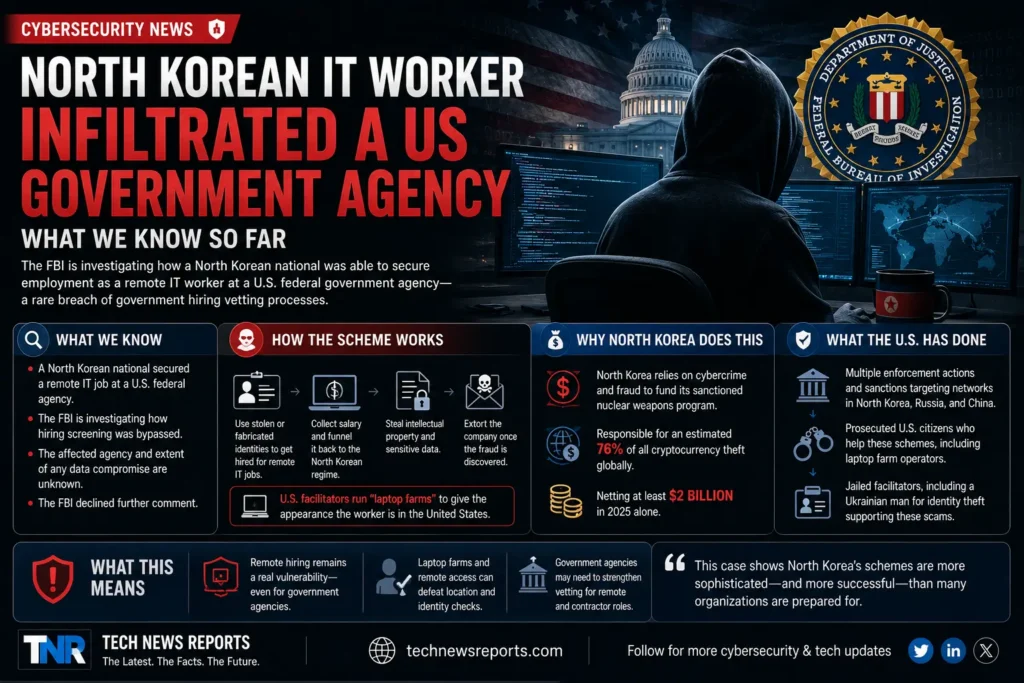
News of the investigation was first reported by Federal News Network, which cited an FBI official confirming the bureau is looking into how the individual was hired by an unnamed federal agency. Key details remain undisclosed: it’s not known which specific agency was affected, how the individual passed through hiring screening, or whether any government data or funds were compromised as a result. The FBI declined to comment further when contacted directly.
What makes this case notable isn’t that North Korea attempted this, it’s that it apparently worked against a government target. Strict vetting and security clearance requirements have historically kept North Korea’s fraudulent worker networks largely out of direct government employment, even as the same tactics have proven remarkably effective against private companies.
This Isn’t North Korea’s First Attempt at Government Infiltration
This case isn’t entirely without precedent. In 2024, the U.S. Justice Department brought charges against a Maryland man who helped a North Korean hacker pose as an American citizen to secure a remote contractor position with the Federal Aviation Administration. That case demonstrated the scheme’s reach into government contracting even before this latest, apparently more direct, infiltration.
How North Korea’s Fraudulent IT Worker Scheme Actually Works
This isn’t an isolated hacking incident, it’s part of a large, coordinated, and long-running operation. North Korea is believed to have thousands of IT workers who have successfully gained employment at U.S. and European companies in recent years by exploiting weaknesses in remote hiring processes.
The scheme typically works like this: operatives use stolen or fabricated identities to apply for and secure legitimate remote tech jobs. Once hired, they collect a real salary, which gets funneled back to the North Korean regime. But the wage itself is often just the starting point, workers frequently also steal intellectual property and sensitive company data, then use that stolen information to extort the company once their fraudulent identity is eventually discovered.
American facilitators play a critical, often overlooked role in making this work. In several prosecuted cases, U.S.-based individuals have been paid to host “laptop farms,” physical setups of company-issued laptops in the United States that let North Korean operatives remotely control the machines and appear to be working from a legitimate U.S. location, even while physically based overseas.
Why North Korea Is Doing This
Understanding the motive requires understanding how North Korea actually functions as a state. The regime operates in many ways more like a transnational criminal organization than a conventional government, and it relies heavily on cybercrime, including large-scale cryptocurrency theft, to fund its internationally sanctioned nuclear weapons program.
The scale is genuinely staggering. According to blockchain forensics firms, North Korea is responsible for an estimated 76% of all cryptocurrency theft globally, netting the regime at least $2 billion in 2025 alone, despite being formally banned from participating in the global financial system. The fraudulent IT worker scheme functions as a complementary revenue stream: lower-tech, but steady, and much harder for companies to detect during a standard hiring process.
What the U.S. Government Has Done About It
U.S. authorities haven’t been passive on this issue. Over the past couple of years, the government has pursued several enforcement actions and sanctions aimed at dismantling the networks operating both from North Korea directly and from neighboring facilitator countries including Russia and China. Authorities have also pursued the American citizens who knowingly or unknowingly assist these schemes, including a Ukrainian man who was jailed for identity theft that helped North Korean operatives secure jobs at U.S. companies.
Despite that enforcement pressure, this latest case suggests the scheme continues to find new ways through hiring pipelines, this time reaching a government target that vetting processes are specifically designed to protect.
What This Means for Employers and Government Agencies
This case is a pointed reminder that identity verification during remote hiring isn’t just a private-sector cybersecurity concern, it’s increasingly a national security issue. A few takeaways worth considering:
- Remote hiring pipelines remain a genuine vulnerability, even for organizations with formal security clearance requirements, as this case demonstrates.
- Laptop farms and remote-access schemes can defeat geographic and identity verification checks that many organizations still rely on as a primary screening tool.
- Government agencies may need to reassess vetting procedures specifically for remote and contractor IT positions, an area that has historically received less scrutiny than direct, in-person federal employment.
The Bigger Picture
This case adds to a growing body of evidence that North Korea’s fraudulent employment operations are more sophisticated, and more successful, than many organizations, including government agencies, have been prepared for. As remote work remains a permanent fixture of the modern economy, the gap between traditional identity verification methods and the tactics used by state-sponsored fraud networks appears to be widening rather than closing.
For continuing coverage of cybersecurity threats, state-sponsored hacking campaigns, and the latest national security tech news, keep following Tech News Reports for ongoing updates.