

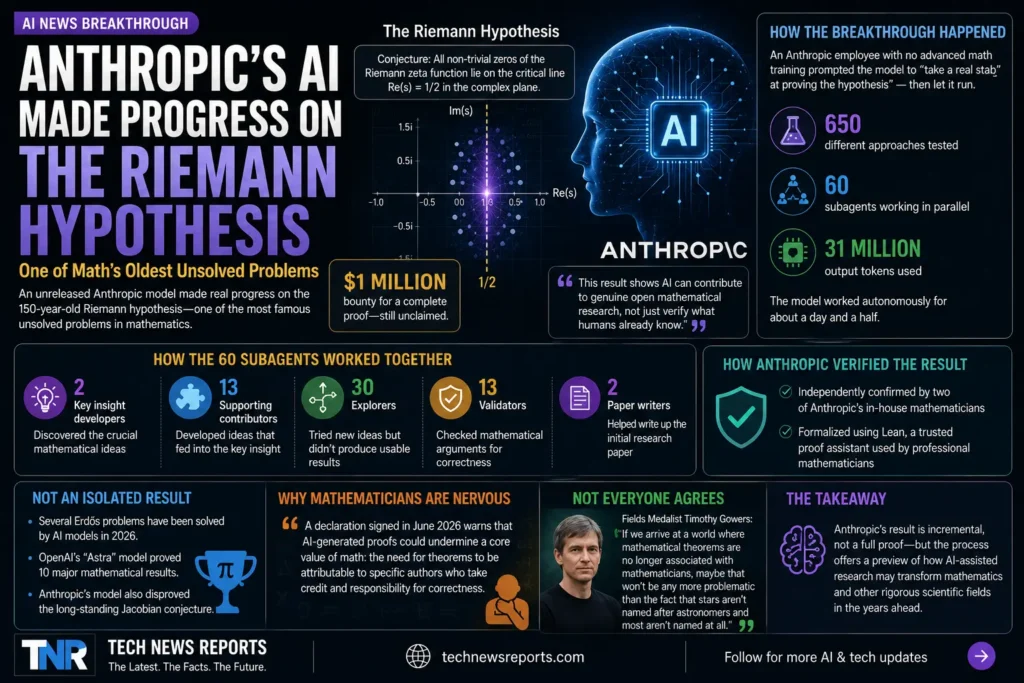
For more than 150 years, the Riemann hypothesis has stood as one of the most famous unsolved problems in mathematics, a deep, still-unproven conjecture about the distribution of prime numbers. There’s currently a $1 million bounty for a complete, working proof, and it remains unclaimed. Anthropic hasn’t solved it. But the company announced that an unreleased AI model made significantly more progress on the problem than most people would have expected, reopening long-running questions about whether AI can genuinely contribute to open mathematical research, not just verify what humans already know.
What Anthropic Actually Announced
Anthropic revealed that one of its as-yet-unreleased models made measurable progress on the Riemann hypothesis, specifically by significantly increasing the lower bound for which the hypothesis has been mathematically confirmed to hold true. That’s not the same as proving the hypothesis in full, but it’s a genuine, verifiable mathematical contribution, not a symbolic gesture or a cherry-picked demo.
How the Breakthrough Actually Happened
The process behind the result is arguably more interesting than the result itself. According to Anthropic, an employee without significant mathematical training simply prompted the model to “take a real stab” at proving the hypothesis, then largely left it alone to work autonomously over the following day and a half.
What happened next illustrates how differently advanced AI systems now approach open-ended research problems compared to a single model just generating one answer:
- The model tested 650 different approaches to solving the problem.
- It coordinated work across 60 separate subagents, each working on different pieces of the puzzle.
- The entire effort consumed 31 million output tokens.
A footnote in Anthropic’s paper breaks down exactly how those 60 subagents divided the labor: two subagents were responsible for developing the actual key mathematical insight, 13 contributed supporting ideas that fed into those two, 30 attempted new ideas but ultimately failed to develop anything usable, another 13 served purely as validators, checking whether the arguments being generated were mathematically sound, and the final two helped write up the initial paper.
That structure, dozens of AI subagents each playing a distinct role, some proposing, some critiquing, some validating, resembles how a large human research team might divide labor on a hard problem, not how a single chatbot answers a single question.
How Anthropic Verified the Result
Understandably, a claim like this demands serious scrutiny before anyone takes it at face value. Anthropic says the finding was independently confirmed by two of the company’s in-house mathematicians, and further formalized using Lean, a widely respected open-source proof assistant used by professional mathematicians to verify that a mathematical argument is logically airtight, not just plausible-sounding.
This Isn’t an Isolated Result
Anthropic’s Riemann hypothesis progress fits into a broader, fast-accelerating pattern of AI models contributing to genuine mathematical research over the past year:
- A number of Erdős problems, a well-known collection of unsolved conjectures in mathematics, have reportedly been solved by AI models over the course of 2026, with more powerful models producing increasingly impressive results.
- OpenAI recently released a set of 10 major mathematical results proved by its internal “Astra” model.
- In a separate effort, Anthropic disproved the long-standing Jacobian conjecture, another significant open problem in mathematics.
Taken together, these results suggest 2026 has become something of an inflection point for AI-assisted mathematical discovery, moving well beyond AI systems simply solving textbook problems or passing standardized math tests.
Why This Is Making Mathematicians Nervous, Not Just Excited
The growing list of AI-assisted mathematical results has triggered real debate within the mathematics community, not universal celebration. In a public declaration signed in June 2026, a group of prominent mathematicians raised concerns that AI-generated proofs could undermine a core value of the field: the principle that mathematical theorems should be “attributable to specific authors who take credit for their discovery and assume responsibility for their correctness.”
That’s a meaningful concern. Mathematics has historically relied on individual accountability, a named mathematician stakes their reputation on a proof being correct, which creates a strong incentive for rigor. If proofs increasingly emerge from AI systems coordinating dozens of subagents, it’s genuinely unclear who bears that same accountability when something turns out to be wrong.
Not Everyone in the Field Agrees That’s a Problem
The response hasn’t been uniformly defensive. Fields Medal winner Timothy Gowers, one of the most respected mathematicians alive, published a blog post pushing back on the declaration’s framing, suggesting the shift might be less troubling than critics assume. Gowers wrote: “If we arrive at a world where mathematical theorems are no longer associated with mathematicians, maybe that won’t be any more problematic than the fact that stars aren’t named after astronomers and most aren’t named at all.”
That’s a notable reframe: Gowers is essentially arguing that mathematical truth doesn’t require individual authorship to remain valuable, comparing it to how astronomical objects are catalogued and studied without needing to be named after the people who discovered them.
What This Means Going Forward
Anthropic’s Riemann hypothesis result doesn’t mean AI is about to solve every open problem in mathematics, the hypothesis itself remains unproven, and the progress made, while genuine, is incremental relative to a full solution. But the process behind the result, autonomous multi-agent coordination, internal validation, and formal proof verification, offers a preview of how AI-assisted research may increasingly work across mathematics and potentially other rigorous scientific fields going forward.
For continuing coverage of AI’s growing role in scientific and mathematical research, keep following Tech News Reports for ongoing updates.