

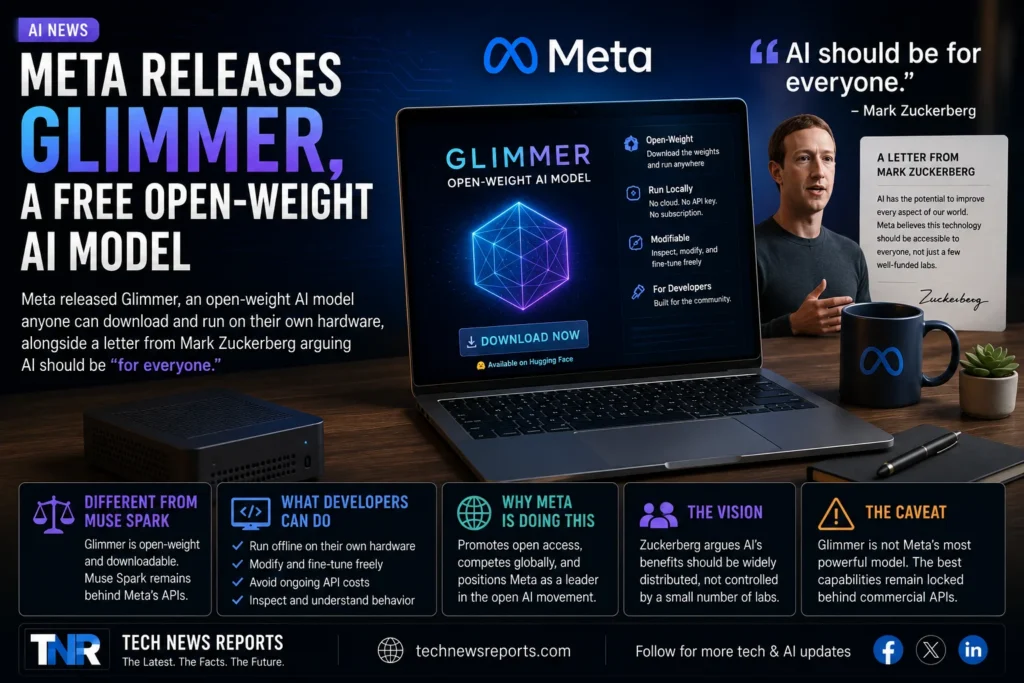
Meta has released Glimmer, a new open-weight AI model that anyone can download and run directly on their own hardware, no cloud subscription, no API key, no ongoing cost. The release landed alongside a lengthy public letter from CEO Mark Zuckerberg arguing that AI should be “for everyone” rather than controlled by a small handful of labs, a framing that’s already drawing skepticism from industry observers who note the vision comes with some real caveats.
What Is Glimmer, and How Is It Different From Meta’s Other AI Models?
Glimmer stands in direct contrast to Muse Spark, Meta’s more powerful flagship AI model, which remains locked behind Meta’s own APIs and isn’t available for anyone to download and run independently. Glimmer, by comparison, is released with its weights, the actual trained parameters that determine how the model behaves, made publicly available, meaning developers and hobbyists can download it, inspect it, modify it, and run it entirely on their own infrastructure.
This “open-weight” approach is a specific strategic choice that differs meaningfully from a fully closed model like Muse Spark. It gives up some of the control and monetization advantages of keeping a model locked behind a paid API, in exchange for broader adoption, community goodwill, and positioning Meta as a champion of accessible AI, at least for this particular model.
The Letter: “AI Should Be for Everyone”
Alongside the Glimmer release, Zuckerberg published a letter arguing that AI’s benefits should be broadly distributed rather than concentrated among a small number of well-funded labs capable of building and controlling the most powerful models. It’s a continuation of themes Zuckerberg has pushed publicly throughout 2026, including in his lengthier manifesto on personal superintelligence published earlier this month, where he laid out a vision of widely accessible AI tools reshaping education, work, and daily life for the better.
Why Critics Say the Vision Comes With Asterisks
Industry observers covering the release have pointed out an important tension in Meta’s framing: Glimmer is genuinely open and freely downloadable, but it’s explicitly not Meta’s most capable AI system. That distinction matters. Meta gets to claim the public relations and goodwill benefits of championing “AI for everyone” while keeping its actual most powerful model, Muse Spark, restricted to its own commercial APIs, where Meta retains full control over pricing, access, and usage terms.
In other words, the “for everyone” framing applies specifically to a mid-tier model, not to the frontier capability Meta has actually built. Critics argue that’s a meaningfully different claim than the sweeping, egalitarian language in Zuckerberg’s letter might suggest to a casual reader.
Why Meta Is Doing This Now
This release fits into a broader competitive and strategic pattern that’s been building throughout 2026. Meta has consistently positioned open-weight AI as a point of differentiation from rivals like OpenAI, Google, and Anthropic, which have generally kept their most capable models closed and accessible only through paid APIs. By contrast, Meta has repeatedly emphasized open access as core to its AI strategy, both as a genuine philosophical position and as a competitive lever against companies that don’t operate the same way.
There’s also a global competitive dimension worth noting. Chinese AI labs have been aggressively releasing increasingly capable open-weight models throughout 2026, intensifying global competition in the open-source AI space. Meta’s continued open-weight releases, including Glimmer, help position the company, and by extension the broader U.S. AI industry, as a credible counterweight in that international race, rather than ceding the open-model space entirely to overseas competitors.
What Developers Can Actually Do With Glimmer
Because Glimmer is released with open weights, developers gain several concrete capabilities they wouldn’t have with a closed, API-only model:
- Run it entirely offline, with no dependency on Meta’s servers or an internet connection once downloaded
- Modify and fine-tune it for specific use cases without needing permission from Meta
- Avoid ongoing API costs, since there’s no per-token or subscription pricing once the model is running on your own hardware
- Inspect its behavior directly, which matters for developers and researchers who want more transparency into how a model actually works rather than treating it as a black box
The Bigger Picture
Meta’s Glimmer release is a genuine contribution to the open-weight AI ecosystem, and it’s fair to say it does meaningfully expand access to capable AI technology for developers and hobbyists who can’t or won’t pay for cloud-based frontier models. But the gap between Zuckerberg’s sweeping “AI for everyone” framing and the more specific reality, that Meta’s actual best model remains commercially restricted, is a useful reminder that even genuinely valuable open-source contributions from major AI labs are usually calibrated carefully around what a company is and isn’t willing to give away.
For continuing coverage of open-weight AI models, Meta’s AI strategy, and the broader competitive landscape shaping AI access in 2026, keep following Tech News Reports for ongoing updates.