

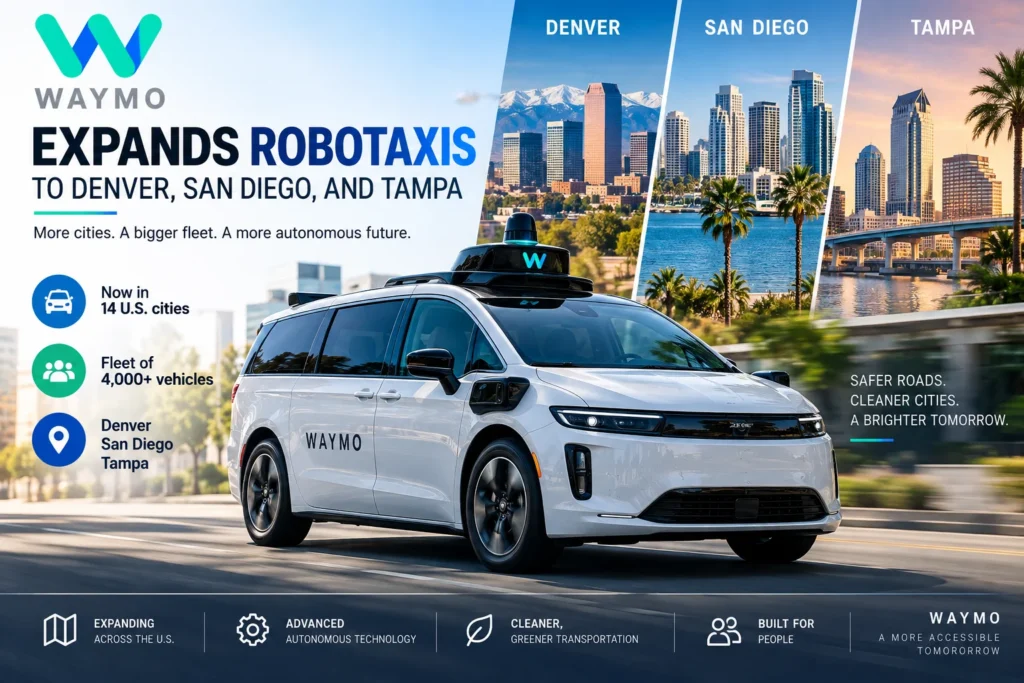
Waymo has started offering its robotaxi service to the public in Denver, San Diego, and Tampa, extending the Alphabet-owned company’s commercial operations to 14 U.S. cities. The expansion comes as rival Tesla pushes to close the gap in the robotaxi market with its own driverless service and upcoming Cybercab.
How the Rollout Works
Waymo said it will begin inviting riders on a rolling basis and slowly ramp up access in the three new cities, following the same commercial playbook it has used in every prior market: first mapping and testing the autonomous driving technology, then removing the human safety operator, and eventually opening the service to employees, media, and other invited guests before public riders. How quickly Waymo opens to paying riders typically depends on local regulatory approval, since some states, including California, require permits from separate agencies covering deployment on public roads and the ability to charge fares.
The expansion has grown Waymo’s fleet to more than 4,000 vehicles, combining its established Jaguar I-Pace hatchbacks with a newer, Zeekr-made minivan called the Ojai. Notably, in Denver and San Diego, the Ojai will be the only vehicle available to riders, a shift from Waymo’s Jaguar-dominated fleet in most other markets.
What the Ojai Brings to the Fleet
The Ojai, pronounced “oh-hi,” features Waymo’s sixth-generation self-driving system and was designed specifically to be cheaper to build, operate, and maintain than the Jaguar I-Pace. Its fleet remains relatively small at around 300 vehicles compared to Waymo’s broader I-Pace numbers, but the company expects it to scale quickly as Waymo pursues profitability alongside continued geographic growth.
The Competitive Pressure From Tesla
Waymo’s latest expansion lands directly amid Tesla’s own push into the robotaxi market. Tesla now charges for rides in its driverless Model Y vehicles in Austin, Dallas, Houston, Miami, Orlando, and Tampa, with service still limited in some of those markets but expanding. Tesla is also banking heavily on its Cybercab, a custom two-seater built with no steering wheel or pedals, to accelerate its robotaxi ambitions. Tampa now stands out as a market where both companies will be operating driverless services simultaneously, giving riders a rare direct head-to-head comparison.
Waymo’s Broader Growth Timeline
Waymo’s current expansion pace traces back roughly 18 months, a run that has cemented its position as the U.S. robotaxi market leader. The company operated in Phoenix for years before securing full permits to charge for driverless rides in San Francisco in August 2023. It expanded into Los Angeles in 2024, but its growth truly accelerated in March 2025, when it opened robotaxi service to riders in Austin through a partnership with Uber. Since then, Waymo has launched commercial service in Atlanta, Dallas, Houston, Miami, Nashville, Orlando, and San Antonio.
The expansion isn’t slowing. Last month, the Nevada Transportation Authority unanimously approved a permit allowing Waymo to operate up to 1,000 autonomous vehicles in Clark County, home to Las Vegas, over the next year, the same approval process that also cleared Tesla and Uber to operate there. Internationally, Waymo is also planning robotaxi launches in London and Munich.
Why It Matters
Waymo’s expansion into three more U.S. cities in a single announcement, alongside international plans for London and Munich, underscores just how aggressively the company is scaling ahead of increasing competition from Tesla and other robotaxi entrants. The introduction of the cheaper-to-operate Ojai minivan as the exclusive vehicle in two new markets also signals Waymo’s shift toward balancing continued geographic growth with a clearer path to profitability, rather than expansion for its own sake. For riders, the direct overlap with Tesla’s robotaxi service in Tampa specifically offers one of the first real markets where consumers can directly compare the two companies’ approaches to driverless rides.
For continuing coverage of autonomous vehicles and the robotaxi market, keep following Tech News Reports for ongoing updates.