
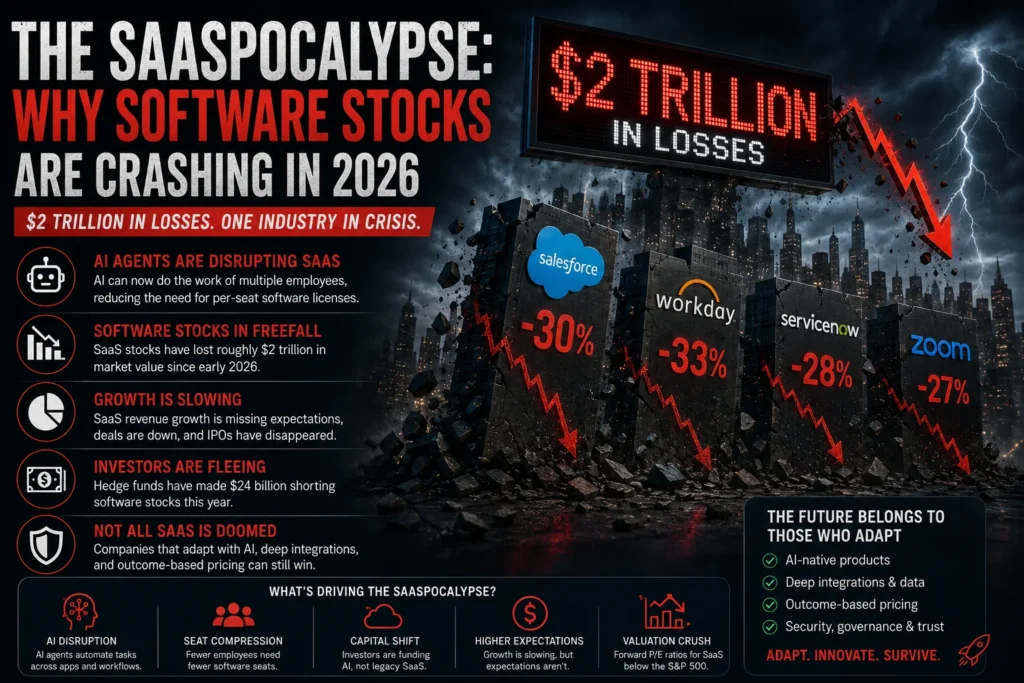
If you follow software industry news even casually, you’ve probably seen the term “SaaSpocalypse” floating around this year. It’s not just a dramatic headline. Software-as-a-service stocks have genuinely lost roughly $2 trillion in combined market value since early 2026, even as the broader stock market has stayed relatively flat. Salesforce is down more than 30% for the year. Workday has fallen 33%. The iShares Expanded Tech-Software Sector ETF, a broad benchmark for the software industry, is down more than 20%.
Here’s a full breakdown of what’s actually driving the SaaSpocalypse, why it’s different from a typical market correction, and what it means for the future of enterprise software.
Where the Term Came From
The phrase “SaaSpocalypse” was coined by Jefferies equity trader Jeffrey Favuzza in February 2026, as software stocks began sliding hard in response to a wave of new AI product launches. What started as a specific reaction to a handful of announcements quickly turned into a broader, sustained narrative that’s continued rolling through the industry for months.
Hedge funds have reportedly earned roughly $24 billion shorting software stocks during the selloff, and trading activity has been described by market participants as “get me out” style selling, investors exiting positions quickly rather than waiting to see how the story develops.
The Core Fear: AI Agents Replacing SaaS Itself
The underlying anxiety driving the SaaSpocalypse is straightforward, even if the consequences are complicated. For roughly two decades, the software industry’s most successful business model has been per-seat SaaS licensing: companies pay a recurring fee for every employee who uses a given piece of software, whether that’s a CRM, an HR platform, or a project management tool.
AI agents threaten that model directly. If a single AI system can handle tasks that previously required multiple employees logging into multiple separate software platforms, drafting documents, managing workflows, analyzing data, coordinating projects, the argument goes, companies may need far fewer per-seat software licenses to get the same work done. Investors have started calling this dynamic “seat compression.”
One widely cited flashpoint was the release of an advanced AI desktop tool capable of drafting legal documents, building spreadsheets, conducting research, and automating multi-step workflows directly, functions that a wide range of SaaS companies have historically built entire product lines around. The demonstration reportedly wiped hundreds of billions of dollars in market value from public software stocks in a single trading window, in what one European publication dubbed “The Anthropic Effect.”
It’s Not Just Hypothetical Anymore
What’s kept the SaaSpocalypse narrative alive throughout 2026 isn’t just fear of future disruption, it’s evidence that the disruption is already showing up in company fundamentals:
- SaaS revenue growth is genuinely slowing, falling short of Wall Street’s expectations across multiple quarters.
- Companies are actively cutting the number of software vendors they use, consolidating tools as AI coding and automation tools let smaller teams do more with less.
- There have been no notable SaaS IPOs in 2026. According to PitchBook data, roughly 86% of private technology deal value in the first half of the year went to AI companies instead, a dramatic reallocation of investor capital away from traditional software.
- Valuations that once seemed untouchable are being tested in real time. For the first time on record, software companies’ forward price-to-earnings multiples fell below the S&P 500’s overall market multiple, a sharp reversal from the SaaS sector’s historical premium valuation.
A Real Example: Airtable’s Fire-Sale Acquisition
Few stories capture the SaaSpocalypse better than what happened to Airtable. The workflow management startup, once valued at nearly $12 billion at its 2021 peak, was acquired by Italian software buyout firm Bending Spoons for less than $1.3 billion, a decline of roughly 90% from its high-water mark.
Bending Spoons, notably, isn’t an AI company chasing the trend. It’s a buyout firm that also owns established consumer brands like AOL, Evernote, and Vimeo, and it went public itself in July 2026 at a $28 billion market cap. The Airtable deal illustrates a pattern playing out across the software industry: venture-backed companies that raised money at rich, pre-AI-era valuations are now being forced to accept dramatically lower prices, whether through acquisition, down rounds, or continued public market declines.
Is All of SaaS Actually Doomed?
Despite the dramatic framing, most industry analysts don’t believe every software company is facing extinction. A few distinctions matter:
Not all software is equally exposed. Products built around simple, repeatable workflows that AI can automate end-to-end face the most direct pressure. Software with deep enterprise integrations, regulatory complexity, proprietary data, or mission-critical reliability requirements is proving considerably more resistant to AI displacement.
New categories are emerging from the disruption. Analysts point to growth in “AI governance” and “agent orchestration” software, new tools specifically designed to manage, audit, and secure the growing number of autonomous AI agents now operating inside businesses. In other words, the same trend threatening traditional SaaS is simultaneously creating an entirely new software category.
Established players are adapting their pricing models. Rather than sticking rigidly to per-seat licensing, many SaaS companies are shifting toward hybrid or outcome-based pricing, charging based on results delivered or tasks completed rather than the number of human employees with a login.
Which Companies Are Weathering the Storm Better Than Others
Not every software company is experiencing the SaaSpocalypse the same way. A few patterns are emerging in how the market is separating winners from losers:
Infrastructure and data platform companies that AI itself depends on, cloud storage, data pipelines, and compute orchestration, have generally held up better than application-layer SaaS tools, since AI agents still need somewhere to run and data to draw from.
Vertical, industry-specific software with deep regulatory or compliance requirements, healthcare records systems or financial reporting platforms, for example, has proven more resistant than general-purpose productivity tools, since AI still struggles to fully replace the specialized judgment and liability structures built into those workflows.
Companies that moved early to embed AI agents into their own products, rather than treating AI as a bolt-on feature, are generally faring better with investors than those seen as reactive or slow to adapt.
What This Means for Businesses and Investors
For companies evaluating their own software stacks, the SaaSpocalypse is a useful signal to reassess which tools are delivering genuine value versus which have simply become habitual recurring costs. For investors, it’s a reminder that recurring revenue, long treated as a guarantee of durability, is no longer automatically safe from disruption in an AI-driven market.
Whether the SaaSpocalypse ultimately proves to be an overcorrection or a permanent restructuring of the software industry’s business model is still an open question. What’s clear is that 2026 has already become one of the most consequential years in software industry history, and the fallout is far from finished.
For more breaking coverage of the software industry, AI disruption, and enterprise tech trends, keep following Tech News Reports for the latest software news as it happens.