

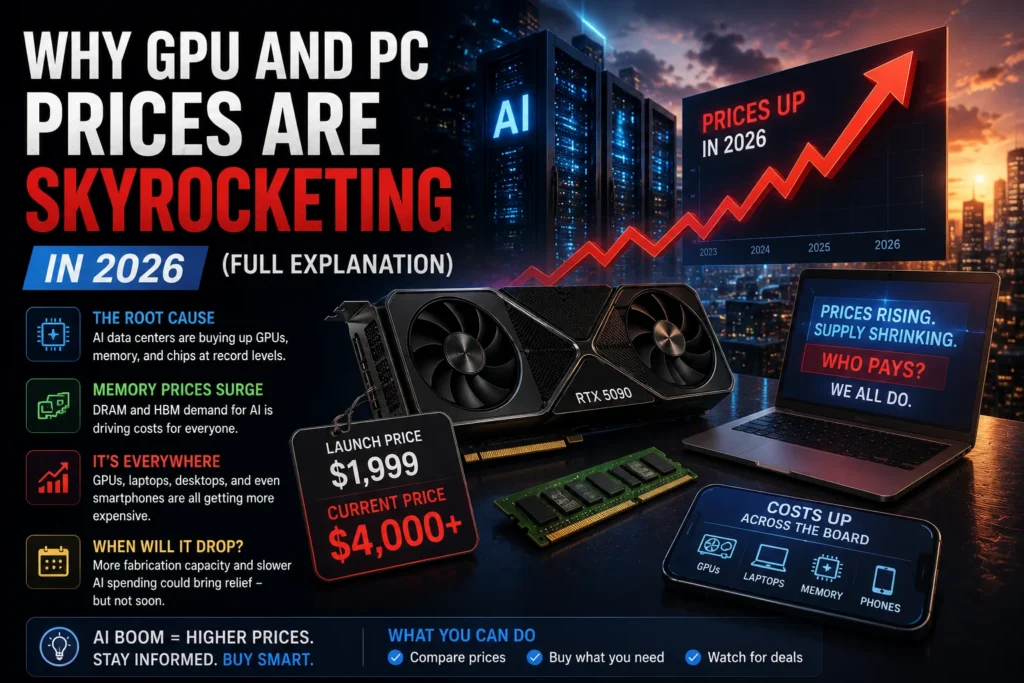
If you’ve shopped for a graphics card, laptop, or even a new phone recently, you’ve probably noticed the same thing everyone else has: prices are climbing fast, and it isn’t slowing down. A Nvidia GeForce RTX 5090 that officially launched around $1,999 is now regularly selling above $4,000. Laptop and desktop memory costs are up sharply. Even Apple, a company known for squeezing suppliers on price, is reportedly struggling to protect its margins on upcoming devices.
The reason behind all of it comes down to one thing: the AI infrastructure boom is eating the world’s chip supply, and consumers are absorbing the fallout.
The Root Cause: AI Data Centers Are Buying Everything
Every major AI company, from Google and Meta to OpenAI and Anthropic, is racing to build bigger data centers filled with GPUs and high-bandwidth memory (HBM) to train and run increasingly powerful AI models. That demand is not small. It’s now large enough to reshape global supply chains for computer hardware.
Memory manufacturers like Samsung, SK Hynix, and Micron have started shifting more of their production capacity toward the high-bandwidth memory used in AI accelerators, since that’s where the biggest profits are right now. The side effect is that conventional DRAM, the memory used in ordinary laptops, desktops, and phones, is becoming scarcer and more expensive.
At the same time, chipmaker TSMC, which manufactures advanced processors for Nvidia, Apple, AMD, and Qualcomm, reported a 45% year-over-year jump in July sales, driven almost entirely by AI chip demand. When the world’s most important chip foundry says demand keeps accelerating, that pressure flows straight down to the products sitting on store shelves.
It’s Not Just Graphics Cards Anymore
For the past couple of years, GPU price hikes were mostly a headache for PC gamers and AI hobbyists running local models. That’s changing fast:
- Apple is reportedly facing margin pressure on its next iPhone lineup due to rising memory costs, with at least one ambitious device design reportedly scrapped over production and cost limitations.
- Intel just raised $15 billion through a stock offering partly to fund expansion into AI-related chip manufacturing, a sign of how much capital is chasing this demand.
- Laptop manufacturers across the board are quietly adjusting prices as component costs climb, even on mid-range and budget models that have nothing to do with AI.
In short, the AI boom that used to be a story about server farms in the desert is now a story about how much you pay for a laptop at Best Buy.
Why This Is Different From Past Shortages
Tech buyers who lived through the pandemic-era GPU shortage might assume this is the same story: temporary supply disruption, panic buying, and eventual normalization. But there’s a key difference this time.
The 2020-2022 shortage was driven by a mix of pandemic supply chain chaos and cryptocurrency mining demand, both of which were temporary shocks. This current price surge is driven by a structural shift in how chipmakers allocate production. AI data center demand isn’t a short-term spike, it’s a sustained, multi-year buildout backed by hundreds of billions of dollars in committed spending from the largest companies in the world.
That means memory and GPU manufacturers have less incentive to prioritize consumer-grade parts over the far more profitable AI-grade components, even as consumer demand stays steady or grows.
When Will GPU and PC Prices Come Back Down?
There’s no clean answer here, but a few factors are worth watching:
- New fabrication capacity coming online. Companies like TSMC, Intel, and Samsung are investing heavily in new manufacturing capacity. As that capacity ramps up over the next one to two years, some of the current supply pressure could ease, though AI demand is also expected to keep growing alongside it.
- Political and regulatory pushback. AI data centers are increasingly facing local opposition over electricity use, water consumption, and infrastructure strain in communities across the U.S. If permitting slows down or projects get delayed, it could modestly ease the pace of new AI hardware demand.
- Whether AI spending itself cools off. Some analysts have started openly questioning the economics of massive AI data center investment. If that spending pulls back for any reason, chip demand could rebalance toward consumer products faster than expected. For now, though, all the public signals, from TSMC’s sales numbers to continued hyperscaler spending, point toward AI demand staying strong.
What This Means for Shoppers Right Now
If you’re in the market for a new PC, laptop, or graphics card, here’s the practical takeaway:
- Don’t expect a return to 2023-era pricing anytime soon. The structural demand driving prices up isn’t going away in the next few months.
- Budget and mid-range hardware is being affected too, not just high-end gaming GPUs, so shopping “down” the product stack won’t fully dodge the price increases.
- Buying now vs. waiting is a genuine trade-off. If you need a device for work or school, waiting for a dramatic price drop may not pay off in the short term. If your purchase is flexible, keeping an eye on new fabrication capacity coming online over the next year is a reasonable strategy.
How Different Buyers Should Approach This Market
Not everyone is affected the same way, so it’s worth breaking this down by buyer type:
Gamers and PC builders: High-end GPUs are the most visibly affected category, with premiums running well above launch pricing on flagship cards. Mid-range cards have held up somewhat better in percentage terms, but availability remains inconsistent. If you’re building a new rig, it’s worth pricing out a full system rather than assuming any single component will be a bargain right now.
Students and remote workers: Budget laptops are seeing smaller but still noticeable price creep, largely tied to rising DRAM costs rather than GPU shortages specifically. Refurbished or previous-generation models are worth a look if raw performance isn’t a priority.
Small businesses and IT buyers: Bulk hardware purchases, especially anything involving upgraded RAM or storage, are getting more expensive to budget for. Locking in vendor pricing early, rather than waiting for a mid-cycle refresh, may be the more predictable option in the current market.
AI hobbyists and local model users: Ironically, the same AI boom driving prices up is also pushing demand for capable consumer GPUs among people who want to run AI models locally. That’s adding yet another layer of demand competing for the same limited supply.
The Bigger Picture
What’s happening with GPU and memory prices in 2026 is really a preview of something larger: artificial intelligence isn’t just changing software and how people work, it’s actively reshaping the economics of physical hardware that has nothing directly to do with AI. A gamer buying a graphics card and a parent buying a school laptop are now competing for the same limited supply chain as the world’s biggest AI labs.
That’s a strange new reality, and it’s likely to stick around for a while.