

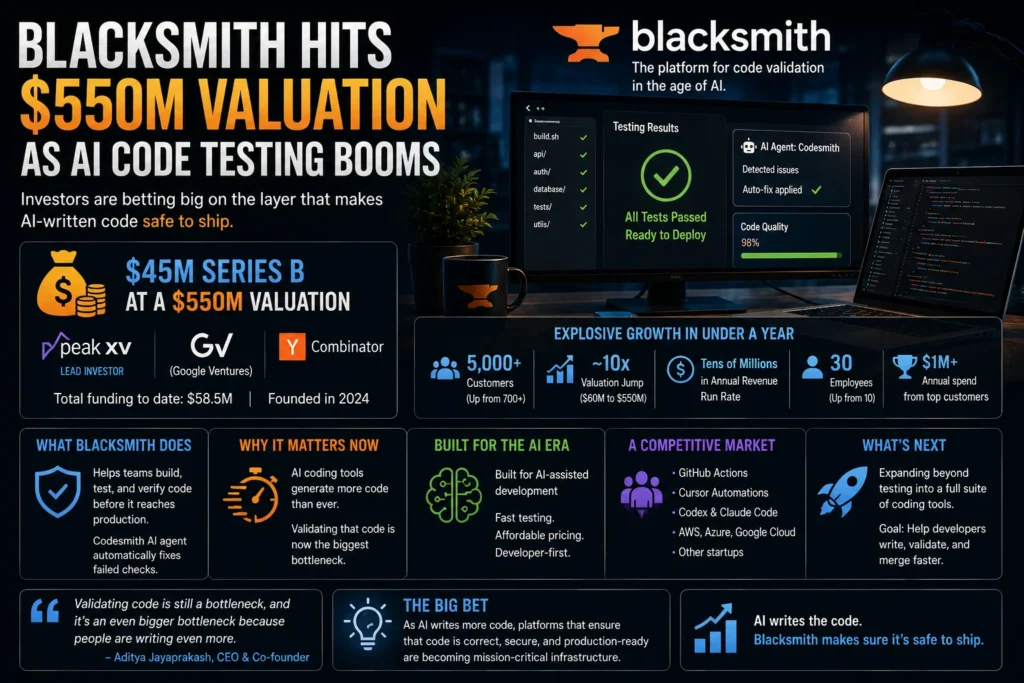
AI coding tools have made writing software faster than ever. But that speed has created a new problem: someone, or something, still has to make sure all that AI-generated code actually works. Blacksmith, a startup built specifically to solve that problem, just closed a $45 million Series B round that values the company at $550 million, up nearly tenfold from the $60 million valuation it held less than a year ago.
The round is a clear signal of where investors think the next big software industry opportunity is hiding, not in writing code faster, but in verifying it before it ships.
The Deal, By the Numbers
The Series B was led by Peak XV Partners, with existing investors GV (Google Ventures) and Y Combinator also participating. That brings Blacksmith’s total funding to $58.5 million since the company was founded in 2024.
To put the valuation jump in context: Blacksmith raised a $10 million Series A at a $60 million valuation less than a year ago. Going from a $60 million valuation to $550 million in under twelve months is an extraordinary trajectory, even by the standards of the current AI funding boom, and it reflects just how fast the company’s actual business has grown alongside it.
What Blacksmith Actually Does
Blacksmith helps software companies build, test, and verify code before it reaches production. The company originally launched as a cloud provider for continuous integration (CI) workloads, essentially running the automated builds and tests that software teams use to catch bugs and confirm code works correctly before it goes live.
Since then, Blacksmith has expanded its platform with Codesmith, an AI coding agent built specifically to automatically fix failed code checks, adding an active repair layer on top of its original testing infrastructure. The pitch to customers isn’t just “we’ll catch your bugs,” it’s increasingly “we’ll catch them and fix them automatically.”
The Growth Numbers Behind the Valuation
According to CEO and co-founder Aditya Jayaprakash, Blacksmith now serves more than 5,000 customers, up from just over 700 less than a year ago, a roughly sevenfold increase in customer count alone. Its client list includes recognizable software names like Mercury, Supabase, Clerk, Ashby, and Expensify.
The revenue trajectory is just as steep. Blacksmith reportedly reached a $10 million annualized revenue run rate with only 10 employees, before scaling its team to about 30 people and growing revenue into the “tens of millions of dollars” range, according to Jayaprakash. He declined to share a specific updated annual recurring revenue figure, but noted that some of Blacksmith’s largest customers now spend more than $1 million a year on the platform, a meaningful sign of enterprise-level trust in the product.
Why This Is Happening Now: The Real Bottleneck in AI-Assisted Coding
Blacksmith’s rise reflects a broader shift the software industry has been grappling with all year. Tools like Cursor, OpenAI’s Codex, and Anthropic’s Claude Code have made it dramatically easier and faster for developers to generate working code. But faster code generation doesn’t automatically mean better code, and it doesn’t remove the need to check that what’s been generated is actually correct, secure, and safe to ship.
“Validating code is still a bottleneck, and it’s an even bigger bottleneck because people are writing even more,” Jayaprakash said.
That’s the core insight driving Blacksmith’s growth: as AI coding tools let individual developers and small teams produce far more code than they used to, the volume of code that needs testing, reviewing, and verifying has scaled right along with it. If anything, the bottleneck has shifted rather than disappeared, moving from “who can write this code” to “who can confirm this code is safe to deploy.”
This mirrors a pattern showing up across the broader software industry right now: as AI accelerates one part of the development pipeline, pressure builds on whatever comes next in that pipeline. Code generation got faster first. Testing, validation, and code review are now catching up to meet that new pace.
A Crowded, Competitive Market
Despite its rapid growth, Blacksmith is operating in a market with no shortage of competition. Its rivals include GitHub Actions, Cursor Automations, the validation features increasingly built directly into Codex and Claude Code themselves, a wide range of other startups targeting the same space, and AI code-testing services offered by major cloud providers including Amazon Web Services, Microsoft Azure, and Google Cloud.
That’s a genuinely difficult competitive landscape, one that includes both nimble startups and the largest cloud infrastructure companies in the world. Jayaprakash said Blacksmith is differentiating on two fronts specifically: speed of testing and affordability, betting that a focused, dedicated product can outperform the testing features bundled into broader coding platforms or cloud suites.
What’s Next for Blacksmith
Looking ahead, Jayaprakash said Blacksmith plans to expand beyond code testing and validation into a broader suite of coding tools, with the goal of helping developers write, validate, and merge software faster across the entire development workflow, not just the testing stage.
That expansion plan puts Blacksmith on a trajectory that looks less like a narrow point solution and more like an attempt to become a fuller platform for the AI-assisted software development lifecycle, a strategy that, if successful, would put it in even more direct competition with the cloud giants and AI coding platforms it currently competes against on testing alone.
Why This Matters for the Software Industry
Blacksmith’s funding round is a useful data point for anyone tracking where investor money is flowing within the AI software boom. While plenty of attention has gone to the AI coding tools generating code in the first place, Blacksmith’s growth suggests real, sustained demand for the layer of infrastructure that comes right after: making sure that generated code is actually trustworthy before it reaches real users.
As more companies lean on AI to write larger shares of their codebases, the ability to validate that code quickly, cheaply, and reliably isn’t a nice-to-have, it’s becoming a core piece of software infrastructure in its own right. Blacksmith’s near-tenfold valuation jump in under a year suggests investors are increasingly betting that code validation will be just as big a business as code generation itself.
For more breaking software industry funding news and the latest developments in AI-assisted development tools, keep following Tech News Reports for continuing coverage.