

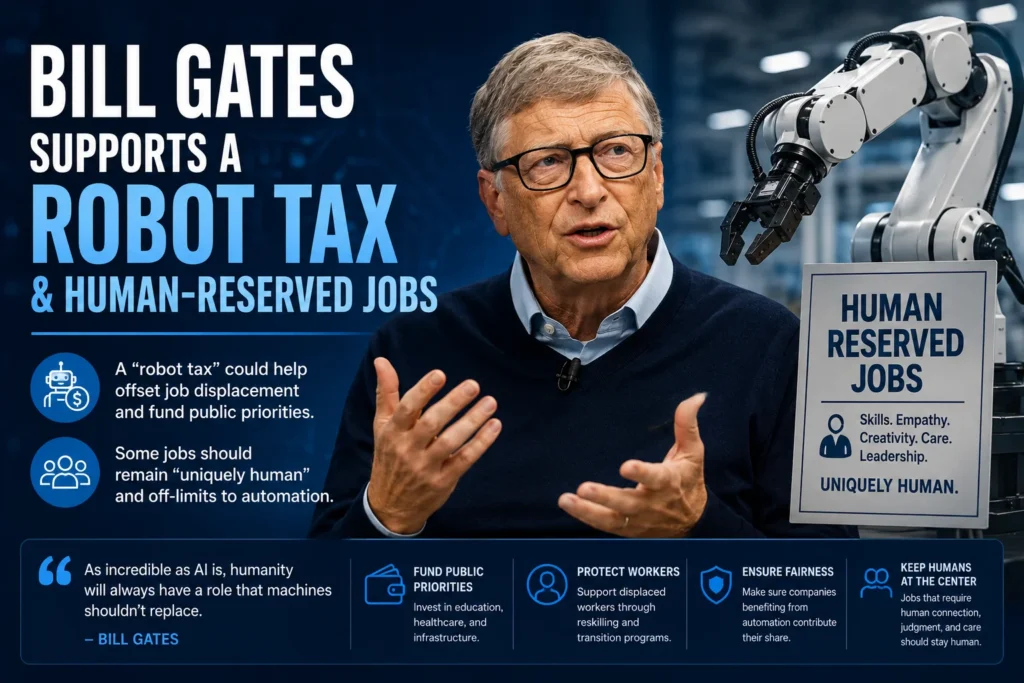
Microsoft co-founder Bill Gates published a lengthy essay on his Gates Notes site this week outlining what he sees as the critical choices facing society during what he calls “a turbulent AI era,” including two policy proposals that go further than most mainstream tech executive commentary on AI’s labor impact.
Where Gates Lands on AI Risk
Gates places himself broadly in the “Responsible AI” camp. He voiced support for the substance of Pacing The Frontier, an open letter from AI industry employees pushing for a deliberate AI development slowdown, while expressing skepticism that such a slowdown would actually be sustainable given competitive pressure across the industry. He also expressed enthusiasm for AI’s potential benefits to science and healthcare, alongside concern about its effects on the labor market, a position broadly consistent with public commentary from Anthropic’s policy team.
The ‘Robot Tax’ Proposal
The most concrete and novel idea in Gates’s essay is a proposed tax on automation itself. As Gates wrote:
“Right now, if you’re an employer and you hire someone, you pay payroll taxes on their earnings. But if you buy a robot, you can usually write it off right away as a business expense. The tax system nudges you toward replacing people with machines. A tax would slow the rush away from human labor a little and raise money for retraining and a stronger safety net.”
The proposal targets a specific structural incentive: current tax policy treats human labor and automated labor asymmetrically, making automation comparatively cheaper from a tax standpoint even when the underlying economics might otherwise favor keeping a human employee. Gates’s proposal would use the resulting tax revenue to fund worker retraining programs and expand the social safety net for displaced workers.
‘Human Reserved’ Jobs
Gates’s second proposal is arguably more novel: designating certain jobs as “Human Reserved,” meaning AI would be formally barred from being used in those roles, regardless of technical capability. He wrote:
“We might set something aside as Human Reserved for economic reasons. For example, we may do it because allowing machines to take over a certain role will displace a large number of people who can’t easily change jobs. You can’t tell a 55-year-old who has worked in construction their whole career that they need to go work at an elder care facility and expect them to find it fulfilling.”
Gates also raised a non-economic rationale for the concept, citing sensitive moments in healthcare as an example: “In health, for example, imagine a robot giving you the awful news that you have an incurable disease. There’s no technical reason why it couldn’t. Yet it shouldn’t.”
He suggested the list of Human Reserved roles would need to evolve over time, potentially with certain jobs protected now and AI phased in gradually over years or decades, with a formal commitment to preserving some roles indefinitely.
Why These Ideas Stand Out
Both proposals share something in common: they would meaningfully reduce the profitability of deploying AI and automation at the pace major AI labs and their enterprise customers are currently pursuing, which may explain why ideas like these haven’t gained much traction in mainstream industry policy discussions to date. A robot tax directly raises the cost of automation. Human Reserved job categories would place hard limits on where AI-driven labor substitution is even permitted, regardless of cost savings.
The Unanswered Questions
Gates’s essay does not resolve some of the most difficult implementation questions his own proposals raise: who would have authority to designate a job as Human Reserved, what specific criteria would govern that designation, how a robot tax would be structured or calculated, and how either policy would be enforced across a global AI industry operating with wildly varying regulatory environments by country. These remain open questions rather than fully specified policy proposals.
Why It Matters
Gates’s essay adds a prominent voice, and two genuinely new policy concepts, to an increasingly urgent debate about how to manage AI’s labor market disruption. Unlike more abstract calls for “responsible AI development,” a robot tax and Human Reserved job categories are concrete, implementable policy mechanisms that lawmakers could act on directly, if there were political will to do so. Given how directly they would affect the profit calculus of AI labs and their enterprise customers, they’re also likely to face significant industry resistance if they gain any serious policy traction.
For continuing coverage of AI policy debates and the labor market impact of automation, keep following Tech News Reports for ongoing updates.