
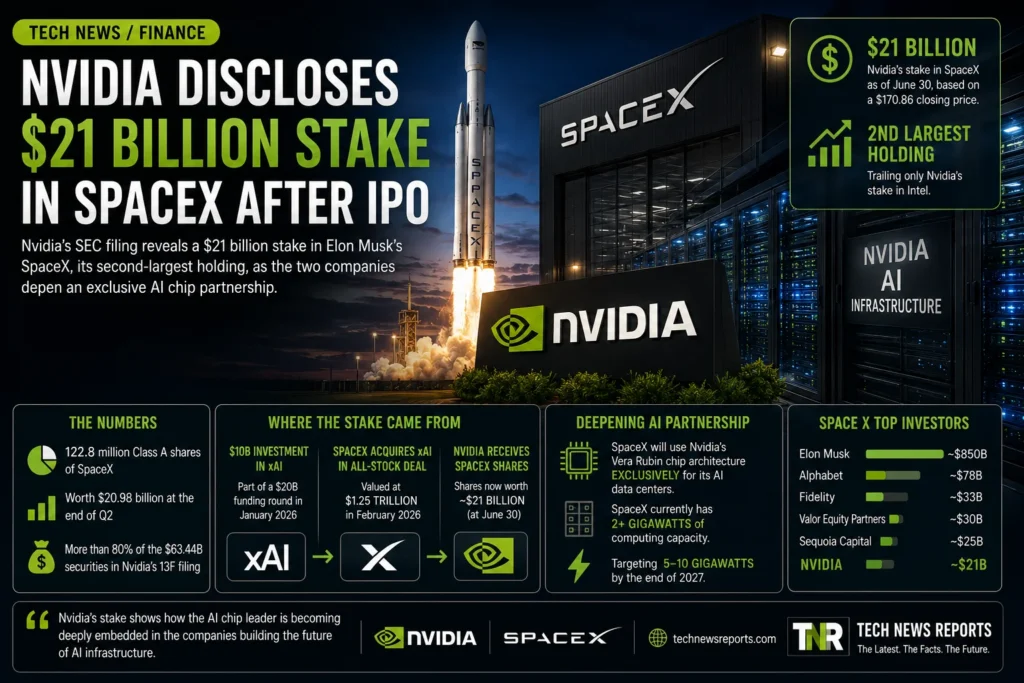
Nvidia disclosed on August 14 that its stake in Elon Musk’s SpaceX was worth approximately $21 billion at the end of the second quarter, making the rocket and satellite company Nvidia’s second-largest publicly disclosed equity holding.
According to a Form 13F filed with the U.S. Securities and Exchange Commission, Nvidia owns 122.8 million Class A shares of SpaceX, valued at $20.98 billion based on SpaceX’s June 30 closing price of $170.86. The stake trails only Nvidia’s holding in Intel, worth roughly $22 billion at the end of the quarter, down from about $30 billion following a recent Intel secondary offering. Combined, the two positions account for more than 80% of the $63.44 billion in securities listed in Nvidia’s filing, which also disclosed smaller stakes in CoreWeave, Coherent, Nokia, Synopsys, Nebius, and Generate Biomedicines.
Where the Stake Came From
Nvidia’s SpaceX shares didn’t come from a direct investment in the rocket company. They originated from Nvidia’s $10 billion investment in Elon Musk’s xAI, part of a $20 billion funding round in January 2026. When SpaceX acquired xAI in an all-stock deal valued at $1.25 trillion in February, xAI investors, including Nvidia, received SpaceX shares in exchange.
Since Nvidia’s original investment, SpaceX has undergone a dramatic transformation. The company completed its long-anticipated initial public offering on the Nasdaq in June, selling 555.6 million Class A shares at $135 apiece to raise roughly $75 billion, one of the largest public debuts in history, valuing the company at approximately $1.77 trillion. By the June 30 valuation date in Nvidia’s filing, SpaceX’s stock had risen to $170.86, though it has since fallen to around $140, cutting the current value of Nvidia’s position to roughly $17 billion.
An Increasingly Deep AI Partnership
The equity stake is only part of a rapidly deepening relationship between the two companies. SpaceX has committed to using Nvidia’s Vera Rubin chip architecture exclusively for its AI data centers, and CEO Elon Musk said on SpaceX’s second-quarter earnings call that Nvidia’s graphics processing units have the “best architecture” for training and running AI models. Musk added that he expects SpaceX will receive a “significant allocation” of Nvidia’s upcoming chip generation.
SpaceX has been aggressively building out AI computing infrastructure inherited from the xAI acquisition, running GPU clusters almost entirely on Nvidia hardware. The company currently has more than two gigawatts of computing capacity and, according to Musk, is targeting somewhere between five and 10 gigawatts by the end of 2027, a buildout that would require an enormous volume of additional Nvidia hardware.
Where Nvidia Ranks Among SpaceX Investors
Despite its sizable position, Nvidia is only the sixth-largest investor in SpaceX, according to data from FactSet. Musk himself remains by far the largest shareholder, with a stake worth approximately $850 billion. Alphabet holds the second-largest position at roughly $78 billion, built from a $900 million investment in SpaceX back in 2015 that the company valued at closer to $94 billion as of July.
Why This Disclosure Matters
Nvidia’s SpaceX stake illustrates a broader pattern reshaping the AI industry’s competitive landscape in 2026: the largest AI chipmaker isn’t just selling hardware to major AI companies, it’s becoming a significant equity holder in them, creating financial ties that extend well beyond a typical customer-supplier relationship. Nvidia has taken similar strategic stakes across the AI ecosystem this year, and separately plans to help raise more than $500 billion from a consortium of investors including Apollo Global, Blackstone, BlackRock, Brookfield Asset Management, Goldman Sachs, and KKR, funding partly intended to help finance Nvidia’s own customers’ purchases of its chips.
That structure means Nvidia’s fortunes are increasingly tied not just to how many chips it sells, but to the market performance and continued AI infrastructure spending of the companies buying them, SpaceX included.
For continuing coverage of AI industry investment, chip supply deals, and the companies shaping AI infrastructure, keep following Tech News Reports for ongoing updates.