
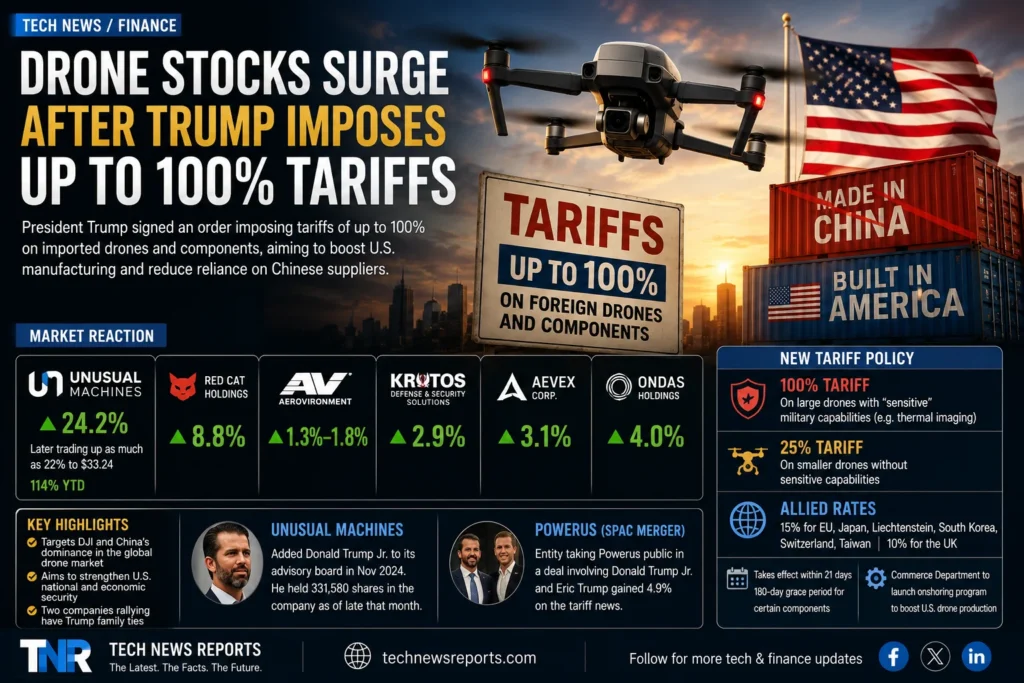
U.S. drone manufacturers rallied sharply after President Trump signed a proclamation imposing tariffs of up to 100% on imported drones and drone components, a move the White House framed as a national security measure aimed at rebuilding domestic manufacturing capacity and reducing reliance on Chinese suppliers.
Shares of Unusual Machines surged 24.2% in the immediate rally, later trading up as much as 22% to $33.24, a gain that built on the stock’s already substantial 114% year-to-date rise heading into the announcement. Red Cat Holdings climbed 8.8%, AeroVironment added 1.3% to 1.8% depending on the session, and defense contractor Kratos Defense & Security Solutions rose 2.9%. Military drone manufacturer Aevex Corp. gained 3.1%, and Ondas, which spans drones, counter-drone technology, and ground robotics, rose 4%.
What the Tariffs Actually Do
According to the White House, the proclamation, signed August 13, subjects large drones with “sensitive” military capabilities, including thermal imaging, to a 100% tariff. Smaller drones without those capabilities face a 25% levy. The administration applied differentiated rates for allied nations: a 15% tariff on drones and parts from the European Union, Japan, Liechtenstein, South Korea, Switzerland, and Taiwan, and a 10% tariff on goods from the United Kingdom.
“U.S. drone production needs to be expanded rapidly to ensure U.S. national and economic security,” the White House said in a release accompanying the order.
The tariffs take effect within 21 days, with a 180-day grace period for components deemed not “particularly sensitive.” The order also directs the Department of Commerce to launch an onshoring program to help support companies investing in domestic drone manufacturing.
Targeting China’s Dominance
The policy is widely understood as directly targeting DJI, the Shenzhen-based manufacturer that has dominated the global commercial drone market for more than a decade. It’s not the first U.S. action against the company: the Pentagon banned DJI systems from military use in 2018 over data security concerns, and the Commerce Department added DJI to its Entity List in 2020. Those earlier measures were largely confined to government procurement. The new tariffs go significantly further, aiming to reshape the broader commercial drone market by making Chinese-made drones and components meaningfully more expensive across the board.
Notable Trump Family Ties
Two of the companies that rallied on the news have documented connections to the Trump family. Unusual Machines, which makes drones and drone components, added Donald Trump Jr. to its advisory board in November 2024; he held 331,580 shares in the company as of late that month. Separately, an entity taking the company Powerus public in a deal involving Donald Trump Jr. and Eric Trump gained 4.9% on the tariff news.
The Numbers Behind the Rally
Some of the rallying companies had already posted notable earnings results in the days before the tariff announcement. Red Cat, which builds tactical military drones through its Teal Drones and FlightWave units alongside autonomous maritime systems through Blue Ops, reported fiscal second-quarter 2026 revenue of $20.19 million against a $22.58 million consensus estimate on August 6, missing on both revenue and earnings. Despite the miss, revenue rose 527% year over year, the company held $325.55 million in cash, and it reaffirmed full-year revenue guidance of $150 million to $180 million.
Kratos beat expectations on August 4, posting adjusted earnings per share of $0.21 against a $0.15 estimate, with revenue of $458.8 million against a $411.33 million consensus. The company raised its full-year 2026 revenue guidance to a range of $1.75 billion to $1.81 billion.
AeroVironment and Kratos, both of which already sell heavily to the Pentagon, saw more modest stock gains than smaller, more commercially exposed peers, since the tariffs change comparatively less for companies already insulated from import competition through defense contracts.
Why This Matters Beyond Drone Stocks
The tariff order reflects a broader escalation in U.S. efforts to decouple critical technology supply chains from China, following a pattern that’s played out across semiconductors, rare earth minerals, and now unmanned aerial systems throughout 2026. For domestic drone manufacturers who have historically struggled to compete against Chinese rivals on price, the tariffs represent a potential opportunity to capture market share, provided they can scale production quickly enough to meet demand that Chinese suppliers currently serve. For businesses and government agencies that rely on drone technology, the tariffs are likely to mean higher near-term costs, at least until domestic manufacturing capacity expands enough to close the price gap.
For continuing coverage of trade policy, defense technology, and the companies benefiting from U.S. manufacturing initiatives, keep following Tech News Reports for ongoing updates.