

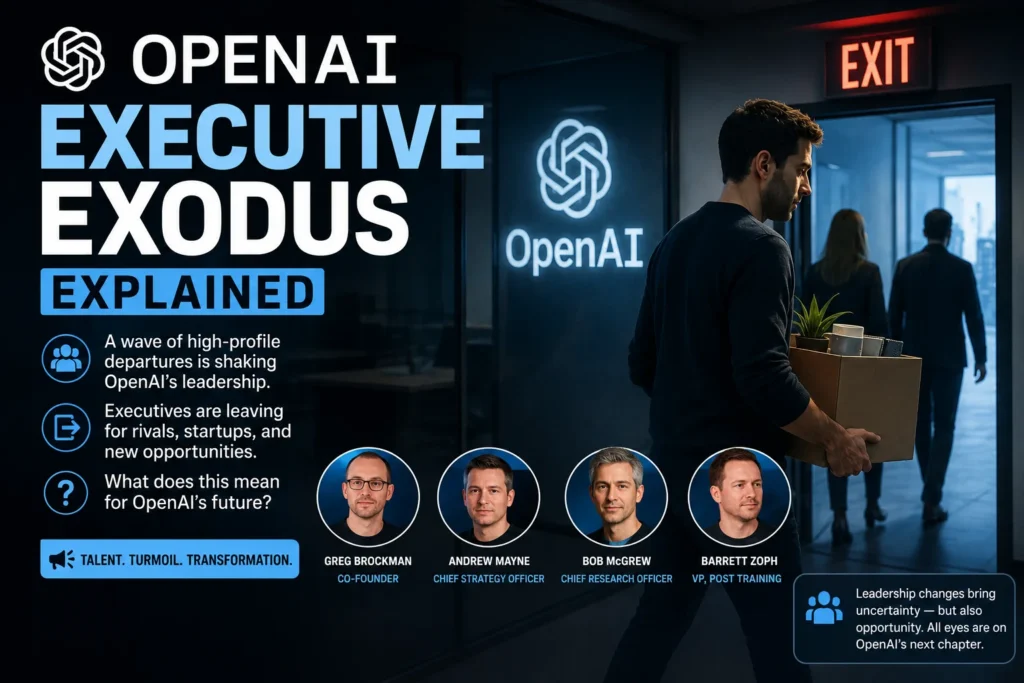
OpenAI has one of the most capable AI models on the market, a desktop app whose user base grew by roughly 15 million subscribers in two months, and confidential IPO paperwork already filed with the SEC. It has also lost more than a dozen executives since the start of the year. Here’s what’s actually driving the departures.
The Departures
Since January, OpenAI has lost a string of senior leaders: CEO Sam Altman’s top deputy Fidji Simo stepped down from her No. 2 role in July; longtime Chief Operating Officer Brad Lightcap announced his departure on August 11; a new chief revenue officer was hired in mid-August following a shake-up; Chief Marketing Officer Kate Rouch exited; and several team leads left earlier in the year as part of what the company described as trimming “side quests.”
Most recently, Chris Malone, OpenAI’s head of data centers since joining in March 2024, left the company last week, a departure OpenAI told TechCrunch stemmed from a reorganization of the infrastructure team, now led by vice president Sachin Katti and reporting to company president Greg Brockman.
The Common Thread: Greg Brockman
The departures coincide with a clear consolidation of power under Brockman, OpenAI’s co-founder and president. Brockman played a central role building OpenAI’s early infrastructure but was relieved of most management responsibilities in 2019, when Altman became CEO. According to Karen Hao’s book “Empire of AI,” Brockman played a disruptive internal role in the years that followed, his technical contributions to projects like GPT-4 were significant, but he also seeded internal rivalries that contributed to the board’s brief 2023 ouster of Altman, an episode often referred to inside the company as “the Blip.” Brockman took a sabbatical in 2024 before returning.
Today, both the infrastructure and product teams report to him. “I like to say that everyone reports to Greg at the end of the day,” Thibault Sottiaux, who leads OpenAI’s API and app offerings, told TechCrunch last week. A senior executive suddenly finding himself several rungs further down the org chart, as appears to have happened with Malone, is a plausible enough reason to leave on its own.
The IPO Pressure
The specter of OpenAI’s planned public listing looms over the reshuffling. The company confidentially filed going-public disclosures with the SEC in June. Tapping public markets would meaningfully ease the capital demands of a compute-hungry frontier lab, but it also means disclosing financials around the same time as rival Anthropic, which is separately preparing its own public debut.
The comparison isn’t flattering for OpenAI on paper: Anthropic is reportedly approaching its first profitable quarter, while OpenAI is reportedly seeing its losses grow alongside its revenue, according to the Wall Street Journal. OpenAI’s IPO isn’t expected until 2027, a notably longer runway than typical; companies that file confidentially usually go public within about five months of filing, and SpaceX did so in under two.
Sam Altman’s own public comments about a difficult past twelve months for the company align with a narrative that OpenAI’s IPO ambitions got ahead of its financial readiness, and that the current reorganization is aimed at boosting revenue and cutting costs before it goes to market.
A Familiar Startup Pattern, in Reverse
There’s a recognizable arc in tech: founders build the product, then bring in experienced operators to scale the company toward a public listing. OpenAI followed that pattern when it brought in veteran executives like Fidji Simo and Kevin Weil. What’s unusual here is the reversal, those operator hires are now departing as Brockman, one of the original founders, reasserts direct control over the org chart.
Why It Matters
For a company preparing to file publicly and compete against a fast-growing, reportedly profitable rival, sustained executive turnover at this scale is a governance signal investors will scrutinize closely during any roadshow. Whether the consolidation under Brockman resolves OpenAI’s cost and revenue challenges before its IPO, or simply trades one form of organizational instability for another, is likely to become clearer as more of the reorganization plays out over the coming months.
For continuing coverage of OpenAI’s leadership, IPO preparations, and the broader AI industry, keep following Tech News Reports for ongoing updates.