
Every so often, Google’s homepage logo transforms into something completely different, a colorful illustration, an animation, or a themed design marking a holiday or historical moment. Most of these “Doodles” are created by Google’s own in-house team. But once a year, Google hands the pen to students across the country through a competition called Doodle for Google. This guide explains exactly what the contest is, how it works, what students can win, and how it fits into Google’s long-running Doodle tradition.
What Is Doodle for Google?
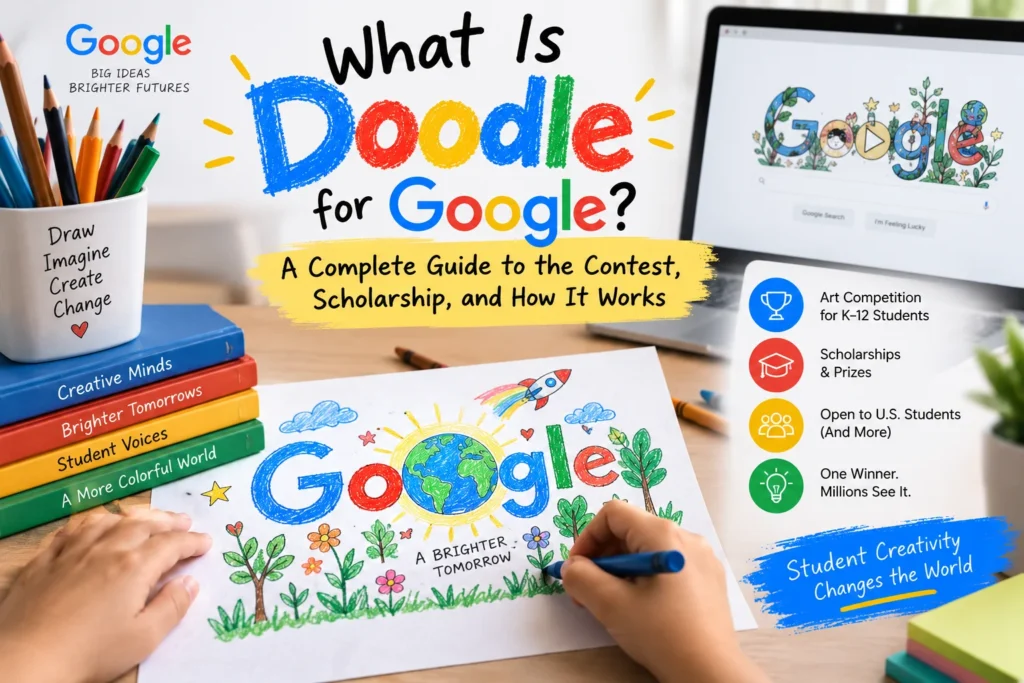
Doodle for Google is an annual art competition open to students in kindergarten through 12th grade at U.S. schools, including homeschooled students and children of military families stationed abroad. Each year, Google announces a new theme, and students are invited to create an original piece of art that reimagines the Google logo around that theme.
Google has hosted the Doodle for Google contest in the United States every year since 2008, making it a well-established annual tradition rather than a one-off promotion. According to Google’s own description of the program, Doodles are meant to “surprise and delight” people who visit Google.com, and past Doodles have celebrated influential figures and moments throughout history. The student contest extends that same spirit of creativity and celebration to young artists directly.
What Is Doodle for Google About? The Theme
Each year’s contest is built around a single theme that changes annually, and every submitted artwork is expected to creatively respond to it. Recent contest themes have asked students questions like “My superpower is…” and “If I could invent one thing to make the world a better place…”, prompts broad enough to invite a huge range of interpretations across age groups, from simple crayon drawings by kindergartners to detailed digital illustrations by high schoolers.
Submissions aren’t limited to traditional drawing. Students can use crayons, paint, clay, found objects, digital art tools, or even video to bring their concept to life, then submit the finished piece electronically as a photo or digital file, along with a short written statement explaining the idea behind their design.
How the Doodle for Google Contest Works
The contest follows a consistent structure each year, though specific dates and prize details can shift slightly from one year to the next.
- Entry period. Google opens submissions for a set window, typically running from mid-October through mid-December, though exact dates vary by year.
- Age divisions. Entries are separated into five grade-based groups: K–3, 4–5, 6–7, 8–9, and 10–12, ensuring younger students aren’t competing directly against older, more technically advanced artists.
- Judging. A panel of judges, which has included notable guest judges from sports and entertainment in past years, narrows submissions down to a group of finalists based on artistic merit, creativity, and how well the piece communicates the year’s theme.
- Public voting. Once finalists are selected, the contest opens to public voting, where people can vote for their favorite Doodle from each grade group.
- National Winner announced. After voting closes, one National Winner is selected. That student’s design is featured on Google’s actual homepage, visible to millions of visitors, for 24 hours.
Doodle for Google Prizes
Prize structures are set by Google and have varied somewhat year to year, but recent contests have followed a consistent general shape:
- National Winner: A college scholarship (recent contests have awarded $45,000), a technology package worth roughly $50,000 for the winner’s school or a nonprofit of their choice, Google hardware, and Google swag, on top of having their design featured on Google’s homepage for a full day.
- National Finalists: Five finalists typically receive a $10,000 college scholarship each, a Chromebook or other Google hardware, and have their artwork featured in the official Doodle for Google gallery.
- State and Territory Winners: Additional regional winners receive Google hardware and public recognition in the contest’s online gallery, even without advancing to the national round.
Because exact scholarship figures and prize packages are set independently each year, students and parents should always confirm current-year prize details directly through Google’s official Doodle for Google contest page before applying.
Doodle for Google Eligibility
To enter, a student generally needs to meet a few core requirements: enrollment in a U.S.-based K-12 school (public, private, or homeschool), including children of military personnel stationed overseas. Parents or legal guardians typically handle registration and submission on behalf of younger students, since the contest spans children as young as kindergarten age.
One notable and increasingly relevant rule: submitted Doodles must be original, human-created artwork. As AI-generated art tools have become widely available, contest rules have explicitly excluded AI-generated submissions, meaning every entry needs to reflect a student’s own artistic work rather than output from an AI image generator.
Why Google Runs This Contest
Beyond the goodwill and media attention a nationwide student art contest generates, Doodle for Google serves a clear purpose for Google as a company: it reinforces the Doodle concept itself, the idea that Google’s homepage logo can be a living, creative canvas rather than a static brand mark, while also directly investing in arts education and college access through real scholarship money and school technology grants. For many participating schools, especially those with limited arts funding, the technology package awarded to finalists’ schools represents a meaningful, tangible benefit that extends well beyond the individual student winner.
Why It Matters
Doodle for Google has grown into one of the most recognizable student art competitions in the country, drawing well over 100,000 entries in recent years according to program guides tracking contest participation. For students, it offers a genuine, low-barrier-to-entry opportunity to have creative work seen by an enormous audience and to compete for meaningful scholarship money regardless of artistic background or formal training. For schools, the technology packages awarded to finalists provide real resources that can benefit an entire student body, not just the individual winner.
What Happens Next
Doodle for Google follows the same general rhythm each year: a new theme announced alongside the opening of submissions in the fall, a judging and public voting period through the following months, and a National Winner revealed with their design featured on Google’s homepage. Students interested in participating in a future contest should watch Google’s official Doodle for Google website for the announcement of each new year’s theme and submission window, since specific dates and prize details are set independently each cycle.
Conclusion
Doodle for Google is Google’s annual invitation to K-12 students across the country to reimagine its homepage logo around a yearly theme, judged on creativity and artistic merit, with real college scholarships and school technology grants on the line. Understanding how the contest’s grade divisions, judging process, and prize structure work is the first step for any student or parent considering an entry, and checking Google’s official contest page each year is the best way to get accurate, current details before submitting.
For continuing coverage of Google’s products and the technology shaping how millions of people use the web every day, visit Tech News Reports.